Off-Season Costa del Sol: What Life Is Actually Like from November to March
British buyers researching a Costa del Sol property invariably ask one question that no brochure answers honestly: what is it actually like in winter? Not the postcard version — the real version. Can you eat out? Is it cold? Is there anything to do? Does the whole place shut down?
The short answer: the Costa del Sol in winter is quieter, cheaper, and in many ways more liveable than summer. The longer answer requires a few honest caveats — which is what this guide is for.
The temperature reality
The Costa del Sol averages 300 days of sunshine per year, and that figure holds in winter. What changes is temperature and predictability.
From November to March, daytime highs typically run 15–19°C — that’s a warm September in the UK. You will not be sunbathing in January (some people do, but they’re the hardy ones). Mornings and evenings drop to 6–10°C, which feels cold indoors because Spanish buildings are designed to stay cool in summer, not warm in winter. If your property has underfloor heating or a quality heat pump, you’re fine. If it has single-glazed windows and a pellet stove from 2003, budget for extra heating costs.
Rain is real. November through February are the wettest months — the Costa del Sol averages 400–500mm of annual rainfall, much of it arriving in short intense bursts rather than the persistent British drizzle. You can have a full week of clear blue sky followed by two days of proper downpours. This is normal, it passes, and it’s why the hills stay green.
Snow is not. The mountains behind Ronda and around Sierra Nevada (90 minutes away) get snow, but at sea level on the coast it essentially never snows. If you see flurries in Marbella, photograph it — it happens perhaps once a decade.
What stays open — and what closes
The honest picture: most things stay open, but with reduced hours and quieter atmospheres.
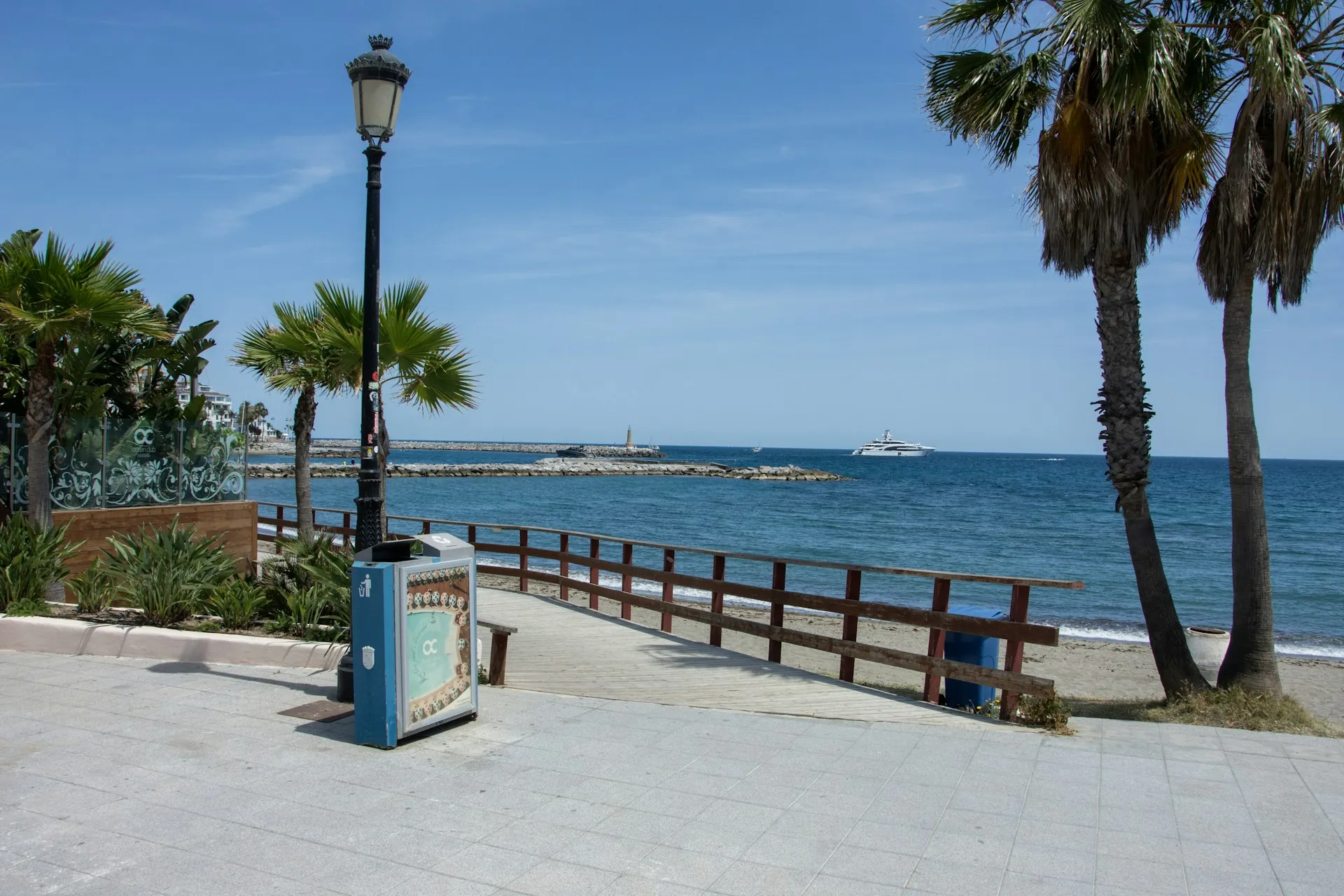
Restaurants and bars: year-round staples — your local Spanish bar, proper restaurants in town centres, supermarkets, pharmacies — all open as normal. The places that close are the beach chiringuitos (most shut October to Easter) and the seasonal beach clubs. Puerto Banús still has open terraces in January; you might need a jacket, but people are dining outside.
Golf courses: all 70+ courses on the Costa del Sol remain open through winter. Many players argue November to February is better — the fairways are in excellent condition after summer stress, the courses are quieter (no 10-minute waits on every hole), and green fees are often 20–40% lower than peak summer rates. If golf was part of your lifestyle calculation, winter is when the Costa del Sol delivers it best.
Supermarkets and shops: Mercadona, Lidl, Carrefour — all open as normal. The Marbella and Estepona town centres stay busy. The big commercial centres (La Cañada in Marbella, El Ingenio in Vélez-Málaga) operate year-round.
Markets: the weekly markets in most towns (Estepona’s Tuesday market, Fuengirola’s Saturday market) continue through winter, albeit with fewer vendors. Some speciality artisan markets run specifically in winter to target local residents.
What genuinely closes: most water parks, certain beach resort facilities, and anything that relies entirely on tourist footfall from July to August. If you’re inland in a small development, some amenity blocks (pools, gyms) in smaller complexes may close November to March — check your community rules before buying.
The expat social calendar
This surprises most people: winter is when the expat community actually socialises properly. In summer everyone is busy with visitors, the beach, and managing the heat. In winter, the regulars emerge.
Quiz nights, bridge clubs, book groups, amateur theatre, language exchange meetups, walking groups — they all ramp up from October onward. Churches with English-language services (Estepona, Fuengirola, Marbella) run full programmes. The International Club of the Costa del Sol runs events most months. Rotary clubs, U3A groups, and dozens of sport-specific clubs fill the social calendar with a consistency that summer doesn’t allow.
The Spanish calendar adds texture: Christmas runs from 22 December to 6 January (the real celebration is Nochevieja on New Year’s Eve, and then Reyes on 6 January when the children get their presents). Carnaval in February brings parades and costumes across most towns. Semana Santa in March or April is a genuinely impressive week-long procession series — particularly in Málaga city, where the cofradías are some of the most elaborate in Spain.
Outdoor life beyond the beach
Winter is hiking season. The Sierra de las Nieves National Park (declared in 2021), the Serranía de Ronda, and the coastal mountains above Nerja and Frigiliana offer serious trail networks in temperatures that make summer hiking dangerous. The El Caminito del Rey gorge walk near Ardales — one of the best day trips in southern Spain — is actually more pleasant in winter than in the July crush.
Cycling, paddleboarding (conditions permitting), birdwatching at the Guadalhorce estuary in Málaga, horse riding through the countryside around Mijas — all of these work better in winter than in summer. The sea temperature stays around 16–17°C until January, which is technically swimmable for those acclimatised to it.
Daylight hours are reasonable: sunset is around 18:00 in December and extends to 20:00 by late March. You get a proper working day of light — unlike northern Spain or the UK in January.
Málaga city as a year-round asset
This is consistently underplayed in property marketing: Málaga is now a genuinely first-rate European city, and it operates year-round regardless of tourist season.
The Picasso Museum, the Thyssen collection (Palacio de Villalón), the Pompidou Centre satellite, the Russian State Museum, the Carmen Thyssen — all open through winter. The Alcazaba and Gibralfaro castle are best visited in winter when you won’t be doing it in 38°C heat. The Mercado de Atarazanas is the best food market in Andalusia and it runs every weekday morning year-round.
Málaga airport — 20 minutes from Marbella, 45 minutes from Estepona — maintains good UK connections through winter. Easyjet, Ryanair, British Airways, Vueling, and Jet2 all run direct services to Manchester, Birmingham, Edinburgh, Bristol, Leeds Bradford, and multiple London airports throughout the year. Frequencies drop slightly versus August, but the routes stay open.
The property market in winter
Winter is a buyer’s window. Not dramatically so — the Costa del Sol market stays broadly strong year-round — but the dynamics shift.
Fewer competing buyers are active. Motivated sellers who listed in summer and didn’t sell are open to negotiation by November. Viewing trips are more relaxed — you can actually park, the agents aren’t juggling six viewings at once, and you get genuine time with a property rather than feeling rushed. Solicitors and gestors are less slammed, so due diligence moves faster.
Crucially, you also see a property at its hardest: how cold it feels indoors, how the heating system copes, whether the terrace catches winter sun or sits in shadow all day, how the drainage handles a week of heavy rain. A property that looks perfect in July can reveal its weaknesses in January. Buying after a winter viewing is buying with eyes open.
The honest downsides
Winter on the Costa del Sol suits some people perfectly and frustrates others. Here is what the marketing doesn’t say:
- If you bought for beach life, winter delivers none of it. The beaches exist but are largely empty and not particularly inviting from December to February. If your lifestyle centres on the seafront, winter is a different and quieter product.
- Smaller developments can feel desolate. A 200-unit resort where 150 apartments are second homes means a lot of shuttered neighbours from October to March. Town-centre properties or developments with a critical mass of full-time residents feel less isolated.
- Driving is essential. The Costa del Sol has almost no usable public transport between towns. Without a car, winter (and summer) are both restrictive. Bus services exist but are infrequent and slow.
- Some new-build snagging is worse in wet weather. If you’re moving into an off-plan completion in winter, inspect drainage, flat roofs, and window seals carefully. Rain reveals construction shortcuts that a dry summer inspection misses.
- The social scene requires effort. The winter community is real, but it doesn’t appear automatically. You need to show up to the quiz nights, join the golf club, attend the church — the expat world here rewards engagement and doesn’t reward passivity.
Who winter suits — and who it doesn’t
Winter on the Costa del Sol is ideal for: retirees and semi-retirees who want a settled year-round life, remote workers who need a comfortable base without tourist chaos, golfers, hikers, people who prefer a genuine local atmosphere over a package-holiday vibe, and buyers doing serious property research who want to see the real picture.
It’s less suited to: buyers who purely want a summer holiday home (in which case winter is irrelevant anyway — they’ll simply not be there), families with school-age children in the UK (Christmas and February half-term give limited windows), and anyone who relies on the high season social buzz of beach clubs and late-night terraces to feel that life is happening.
The key insight: winter exposes the difference between a property investment and a lifestyle investment. If the lifestyle only works in summer, the lifestyle is seasonal — and so is the argument for owning rather than renting. If winter works for you too, then the Costa del Sol delivers on its year-round reputation.
Ready to explore a move?
The best way to understand whether winter on the Costa del Sol suits your lifestyle is to visit in November, January, or February — deliberately, with property viewings in the diary. You’ll see exactly what you’re buying into, in conditions that summer visits don’t show you.
If you’re thinking seriously about a purchase, we work with British buyers at every stage — from the first exploratory visit through to completion. We know which developments have active year-round communities, which areas have the best winter restaurant scenes, and where the golf and lifestyle infrastructure holds up regardless of season.
Get in touch and tell us what you’re looking for — we’ll match you with properties that work for the life you actually want to live, twelve months of the year.
Further reading: Cost of living: Costa del Sol vs the South East of England · Healthcare for British residents on the Costa del Sol · Spain’s Non-Lucrative Visa for British retirees
