Estepona Property for Sale: The Complete Guide for British Buyers
Three years ago I was showing a couple from Surrey around a new-build apartment on Estepona’s New Golden Mile. They had originally come to look at Marbella. By lunchtime they had put down a reservation deposit and were eating anchovies at a harbour-front terrace. That story is not unusual. Estepona converts people.
It is not hard to see why. Prices are roughly 25 to 30 percent lower than in Marbella for comparable properties. The old town has been scrubbed up into something genuinely pretty – flowers on every balcony, pedestrianised streets, a harbour that actually works. The beaches are quieter than the Puerto Banús strip. And the infrastructure – roads, schools, hospitals, golf – is genuinely world-class without the attitude.
This guide covers everything a British buyer needs to know about buying property in Estepona in 2026: prices, areas, the buying process, schools, healthcare, golf, rental yields and the honest version of what life here actually looks like.
In this guide
- Area Overview: What Is Estepona?
- The New Golden Mile: Estepona’s Prime Coastal Corridor
- Old Town Estepona: The Underrated Option
- Property Types in Estepona
- Property Prices in Estepona in 2026
- Why British Buyers Choose Estepona
- Lifestyle in Estepona
- Transport and Connectivity
- Schools in Estepona
- Healthcare in Estepona
- Golf in Estepona and the Surrounding Area
- Beaches in Estepona
- Restaurants and Eating Out in Estepona
- Nightlife and Entertainment
- The Property Buying Process in Spain
- Off-Plan vs Resale in Estepona
- Legal and Tax Notes for British Buyers
- Rental Investment Potential in Estepona
- Community and Expat Life in Estepona
- Estepona vs Marbella: The Honest Comparison
- Working with an Agent in Estepona
- Frequently Asked Questions: Buying Property in Estepona
- Next Steps: Finding Your Property in Estepona
Area Overview: What Is Estepona?
Estepona is a municipality on the western Costa del Sol, in the province of Málaga, Andalusia. It sits roughly 80 kilometres west of Málaga airport and about 20 kilometres west of Marbella, with Gibraltar a further 50 kilometres to the south-west.
The municipality covers a large area, from the coast up into the Serrania de Ronda foothills, and has around 70,000 permanent residents. British buyers tend to focus on two zones: the coastal strip from the town centre west to Cancelada (which agents market as the New Golden Mile), and the old town itself.
The wider municipality includes inland villages such as Casares (separate from Casares Costa on the coast), but the vast majority of foreign property buyers stay within 5 kilometres of the sea.
One thing that surprises people: Estepona is much more Spanish than you might expect. The old town is a functioning Spanish market town, not a resort. That is partly what makes it appealing to buyers who want to integrate rather than just holiday.
The New Golden Mile: Estepona’s Prime Coastal Corridor
The stretch of coast running west from Marbella through San Pedro de Alcántara and into Estepona – broadly from Cancelada to the Estepona town boundary – is marketed as the New Golden Mile. The name was coined by developers in the early 2000s to distinguish it from Marbella’s original Golden Mile (the stretch between the Hotel Marbella Club and Puerto Banús), but it has stuck.
This corridor is where most of Estepona’s high-end new-build development is concentrated. Large gated complexes with communal pools, padel courts, underground parking and 24-hour security have been built here at pace since 2018, and development continues. If you want a new apartment with a south-facing terrace and sea views at a price that would be impossible in Marbella or Benahavís, this is where you look.
Developments here include La Quinta Residences, Alcazaba Hills, Velaya, and dozens of smaller boutique projects. Most are aimed squarely at northern European buyers, particularly British, Irish, Dutch and Belgian.
Old Town Estepona: The Underrated Option
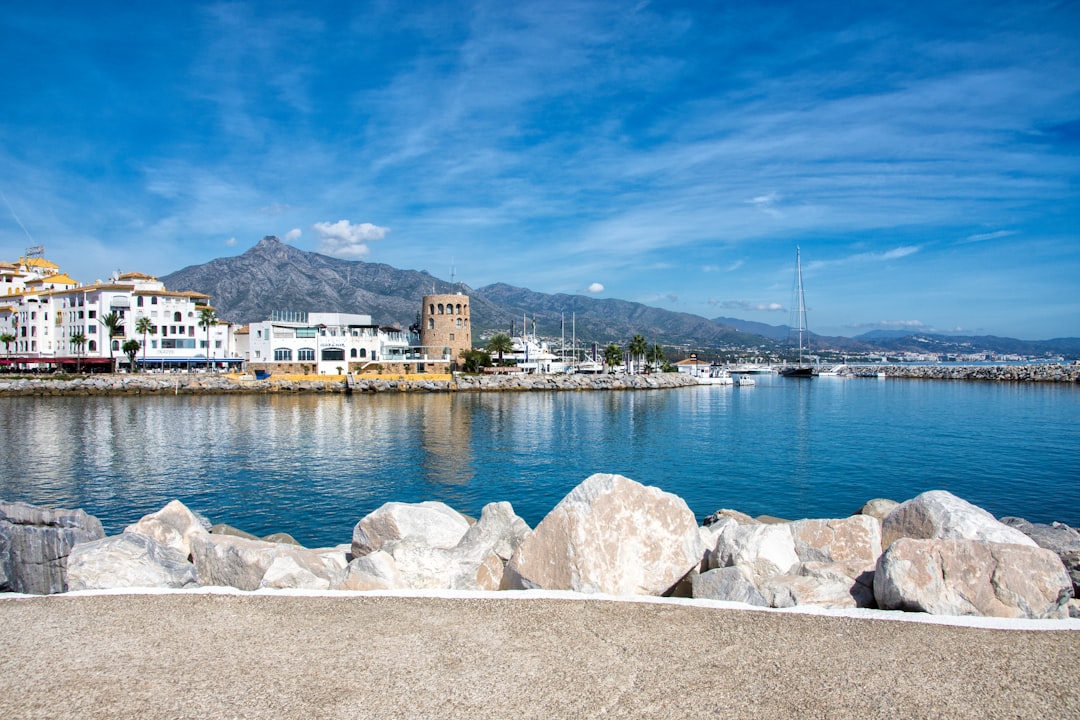
The historic centre – the casco antiguo – has had significant public investment over the past decade. Flower-draped streets, freshly painted houses in white and terracotta, a lively covered market, and a harbour that was redesigned in 2019. It is genuinely pleasant to walk around, which is more than you can say for most Spanish coastal towns.
Property in the old town is almost entirely resale: apartments in older buildings, a few townhouses, and occasional larger villas behind white walls. Prices are lower than the New Golden Mile on a per-square-metre basis, but the apartments are older, community fees are generally lower, and the lifestyle is more integrated into Spanish daily life.
For buyers who want to live in Spain rather than in a gated British enclave, the old town often wins. For those who want a lock-up-and-leave holiday home, the new-build developments on the New Golden Mile are typically more practical.
Property Types in Estepona
New-build apartments and penthouses. The dominant product on the New Golden Mile. Typically 2 or 3 bedrooms, large open-plan living areas, floor-to-ceiling glazing, and south-facing terraces. Most include underground parking and a storage room. Community fees range from €180 to €450 per month depending on the level of facilities.
Resale apartments. Older stock in the town centre and on developments built in the 1990s and 2000s. Generally 20 to 30 percent cheaper on a per-square-metre basis than comparable new-build. Often need updating. Good value for buyers who are comfortable with a refurbishment project.
Townhouses. Available in both old-town resale and as part of larger new-build developments. Typically 3 bedrooms with a private terrace or small garden. A popular choice for families who want outdoor space without the maintenance of a full villa.
Detached villas. Range from modest three-bedroom houses close to the town centre to large luxury villas above the New Golden Mile with sea views, private pools and high-end finishes. New-build villa plots above the coast between Estepona and Cancelada are a particular focus for buyers with budgets above €1.5 million.
Off-plan. A substantial proportion of the Estepona market is off-plan. Several large developments are currently selling from plans, with completion dates between late 2026 and 2028. Off-plan typically offers a 10 to 20 percent discount versus completed product, but carries construction and timing risk.
Property Prices in Estepona in 2026
Estepona prices have risen sharply since 2021, driven by low supply, strong demand from northern Europe, and developer-led new-build activity. However, they remain meaningfully lower than Marbella.
Current benchmarks (early 2026):
- New-build 2-bed apartment, New Golden Mile: €350,000 to €550,000
- New-build 3-bed apartment or penthouse, New Golden Mile: €500,000 to €850,000
- Resale 2-bed apartment, town centre or older developments: €220,000 to €380,000
- Townhouse, 3-bed with terrace, new-build complex: €450,000 to €700,000
- New-build villa with sea views: €900,000 to €2.5 million
- Per-square-metre average, new-build: approximately €3,800 to €4,300/m²
For context: comparable new-build in Marbella Golden Mile runs to €6,000 to €8,000/m². Puerto Banús and Nueva Andalucía are in the €4,500 to €6,500/m² range. Estepona is consistently at the more accessible end of the western Costa del Sol price bracket.
Annual price growth has been running at approximately 8 to 12 percent for new-build in the New Golden Mile corridor. Resale growth has been slower, around 5 to 7 percent, as that segment faces more direct competition from new stock.
Why British Buyers Choose Estepona
British buyers represent one of the largest buyer groups in Estepona, alongside Scandinavians, Dutch and Germans.
The pull factors are consistent across conversations:
Price per square metre. The comparison with Marbella is compelling for most buyers with a budget under €600,000. You simply get more space, better finishes, and newer build quality for the same money.
The 90/180-day rule is workable here. Post-Brexit, British passport holders cannot spend more than 90 days in any 180-day period in the Schengen Area unless they have residency. Estepona is a popular choice for buyers who are keeping their primary UK base but want a proper bolt-hole – the 90-day allowance stretches meaningfully if managed well, and the new-build complexes are designed for lock-up-and-leave use.
Better value for rental income. Estepona’s rental yields are slightly higher than Marbella’s, partly because purchase prices are lower while rental rates for similar quality are not proportionally lower.
Genuine community. The town functions as a real Spanish town. British residents who want to integrate find it easier here than in some of the more touristic Marbella enclaves.
The New Golden Mile lifestyle. For buyers who want the Marbella lifestyle – beach clubs, golf, good restaurants, easy airport access – without the Marbella price tag, the New Golden Mile delivers most of what matters.
Lifestyle in Estepona
The honest version: Estepona is not as glam as Marbella. There is no equivalent of the Puente Romano hotel, no headline beach club scene, and the restaurant offer, while good, is not in the same league as Marbella’s top end.
What it does have is a very liveable, genuinely pleasant daily life. The old town farmers’ market (Tuesday and Saturday mornings at the Mercado de Abastos) is one of the best on the Costa del Sol. The promenade along the port – the Paseo Maritimo – is well maintained and genuinely used by local families rather than just tourists. The pace is slower than Marbella, which most permanent residents consider a feature rather than a limitation.
For retirees and families with younger children, this is often the right balance. For buyers who want the most active social scene on the western Costa del Sol, Puerto Banús – 20 minutes by car – is the answer.
Transport and Connectivity
By air. Málaga Costa del Sol Airport is the main gateway. From Estepona town centre, the drive is approximately 60 to 75 minutes via the AP-7 toll motorway or the N-340 coastal road. From the New Golden Mile (closer to the Marbella border), allow 55 to 65 minutes. Gibraltar Airport is roughly 50 minutes to the south-west – useful for Easyjet flights from the UK, particularly from London Gatwick and Bristol.
Driving within the Costa del Sol. The AP-7 toll motorway runs the length of the coast. Journey times: Marbella 20-25 minutes, Puerto Banús 15-20 minutes, Sotogrande 30-35 minutes, Ronda 60-70 minutes. Parking in the old town centre can be difficult in summer; most new-build complexes include underground parking.
Public transport. The Portillo/Alsa bus service runs along the coastal road between Estepona and Málaga, stopping at San Pedro, Marbella and Fuengirola. Journey time to Marbella bus station is approximately 40 minutes. There is no train service to Estepona – the closest rail connection is Fuengirola (on the Málaga cercanías line). Most residents use a car.
To Gibraltar. Particularly relevant for buyers from the UK who want a Marks and Spencer, a British high street pharmacy, or a Waitrose. The frontier at La Linea de la Concepción is approximately 50 minutes from Estepona. Most British residents make the trip once a month or so for familiar groceries.
Schools in Estepona
International schools. Estepona does not have a major international school within the town itself, but several are within a 20 to 35-minute drive:
- Swans International School (San Pedro de Alcántara, approximately 20 minutes): British curriculum, IGCSE and A-Level. Ages 3-18. One of the most established British curriculum schools on the western Costa del Sol.
- Aloha College (Nueva Andalucía, approximately 25 minutes): British curriculum, IGCSE and A-Level. Ages 3-18. Strong academic reputation.
- The English International College (EIC) (Marbella, approximately 30 minutes): British curriculum. Ages 3-18.
- The International School of Estepona (within the municipality): Smaller, follows a bilingual Spanish-English curriculum. A good option for younger children whose families want more local integration.
Spanish state schools. Several good state primary and secondary schools operate within Estepona. Children of residents are entitled to attend. Teaching is in Spanish. Some families use state school combined with private English-language tutoring.
A practical note for families: Estepona’s proximity to Marbella means the school commute to Aloha or Swans is manageable, but it is a commitment – typically 40 to 50 minutes door to door in morning traffic.
Healthcare in Estepona
Spanish public healthcare. EU citizens registered as residents (Empadronamiento completed plus residency registration) are entitled to use the public Spanish health system. This has improved significantly on the Costa del Sol over the past decade. The nearest public hospital to Estepona is the Hospital de la Serrania in Ronda (inland, about 50 minutes) or Hospital Costa del Sol in Marbella (approximately 25-30 minutes) for more routine care.
Private healthcare. The majority of foreign residents use private health insurance. The two main private hospitals on the western Costa del Sol are Hospital Quirónsalud Marbella and Hospital HLA Vistahermosa (Marbella). Both have English-speaking doctors and staff in most departments. Annual private health insurance for a healthy adult in their 50s runs to approximately €80 to €150 per month with providers such as Sanitas, AXA or Adeslas.
For UK nationals under 90-day rule. If you are not a resident, you cannot access Spanish public healthcare. The GHIC (Global Health Insurance Card, the post-Brexit replacement for the EHIC) gives limited access to state emergency care, but comprehensive private travel/medical insurance is essential.
Golf in Estepona and the Surrounding Area
The Costa del Sol is sometimes called the Costa del Golf for good reason. Within a 30-minute drive of Estepona there are more than 20 golf courses. Several are within the municipality itself:
- Estepona Golf (public, 18 holes): Well-maintained, affordable day fees, good views of the Sierra Bermeja. Popular with residents.
- Valle Romano Golf (private/members): 18 holes, part of a large residential development on the western edge of town.
- El Paraiso Golf (part of the Hotel El Paraiso complex): 18 holes, classic Costa del Sol course, slightly further inland.
The wider area adds major courses including Valderrama (Sotogrande, about 35 minutes – one of Europe’s top-ranked courses), Real Club de Golf Guadalmina, Marbella Club Golf, and La Quinta Golf and Country Club (Benahavís). For serious golfers, the western Costa del Sol is simply one of the best places in Europe.
Beaches in Estepona
Estepona has approximately 21 kilometres of beaches, from the town centre east through Playa de la Rada (the main town beach), west to Playa de El Saladillo and beyond towards Cancelada.
Playa de la Rada is the longest and most accessible beach – about 2 kilometres of grey-brown sand with regular Blue Flag status, chiringuito restaurants, sunbed hire and a promenade path running its full length. It is busy in July and August but manageable in June, September and October.
Playa de El Cristo is a smaller cove closer to the harbour and old town – sheltered, calmer water, popular with families and local residents.
The beaches immediately adjacent to the New Golden Mile developments (between Cancelada and the Estepona town limit) tend to be quieter than Marbella or Puerto Banús beaches. No significant beach clubs in the Nikki Beach or Ocean Club sense – the closest of that type are in Puerto Banús.
Restaurants and Eating Out in Estepona
Estepona’s old town has a genuinely good restaurant scene. The El Chorruelo area (a small square near the market) is worth knowing. Some specific recommendations:
La Escollera (port area): Reliable fresh fish and seafood. One of the town’s most consistently recommended fish restaurants. Grilled dorada (sea bream) and fritura malagueña (mixed fried fish) are the order of business.
La Concha (town centre): Good traditional Spanish cooking. The menú del día (set lunch menu) at €12 to €15 gives you three courses and wine – a useful calibration for how daily eating costs compare to the UK.
Los Arcos (near Mercado de Abastos): Tapas bar that fills up at lunch. Iberian ham, gambas al ajillo (garlic prawns), salmorejo.
El Pulpo (harbour): Seafood-focused, relaxed. The pulpo a la gallega (Galician octopus) does what it says.
The New Golden Mile corridor has restaurants attached to the various hotel and golf complexes, including El Paraiso Country Club and several spots around the Cancelada area. These are more international in style.
Nightlife and Entertainment
Estepona is not a party town. The nightlife is modest compared to Marbella or especially Puerto Banús. There are bar strips in the old town and along the port area that get busy in summer, but this is very much a place that quietens by 1 or 2am.
For buyers who value a quieter life, that is the point. For buyers who want access to the Puerto Banús scene – TIBU, La Sala, Ocean Club – the 15 to 20-minute drive is entirely manageable.
The Fortín cultural centre hosts regular exhibitions, theatre and concerts. The annual Semana Santa (Holy Week) processions in the old town are worth seeing if you are in residence during Easter.
The Property Buying Process in Spain
Buying property in Estepona follows the standard Spanish procedure. For a full step-by-step breakdown, see our guide to buying property in Spain as a UK citizen.
The key steps specific to Estepona buyers:
NIE number. You cannot sign any Spanish property contract without a Spanish tax identification number (NIE). Get this before you start seriously viewing. See our NIE guide for the full process.
Reservation agreement. A small deposit (typically €3,000 to €6,000) to take the property off the market while due diligence is carried out. Refundable if the property has legal issues; not refundable if you pull out without cause.
Private purchase contract (arras). The main binding contract, signed once searches and legal checks are complete. Typically 10 percent of the purchase price paid at this stage. If the buyer pulls out, they forfeit the arras. If the seller pulls out, they pay back double.
Notarial deed (escritura). Completion. Signed in front of a Spanish notary. Full remaining balance (including costs) paid on the day.
Completion costs. Budget 10 to 13 percent on top of the purchase price: – IVA (VAT on new-build): 10 percent – AJD (stamp duty on new-build): 1.2 percent in Andalusia – ITP (transfer tax on resale): 7 percent in Andalusia – Notary and land registry fees: approximately 1 to 1.5 percent – Legal fees: approximately 1 to 1.5 percent of purchase price
British buyers specifically. Post-Brexit, Spanish banks typically require a 30 to 40 percent deposit from non-resident buyers (compared to 20 percent for EU residents). If you need a mortgage, get pre-approval in principle from a Spanish bank before making offers.
Off-Plan vs Resale in Estepona
Off-plan is a significant portion of the Estepona market given the volume of new development on the New Golden Mile. Buying off-plan typically offers a lower entry price (10 to 20 percent below completed comparable), the ability to personalise finishes, and payments structured over the build period.
The risks are real and worth taking seriously: – Construction delays (12 to 18 months beyond promised completion is not unusual) – Developer insolvency (make sure bank guarantees are in place for all stage payments under the Ley 38/1999) – The finished product not matching the renders
Resale is lower risk. You see what you get. Legal checks can be done on an existing property with a documented history. The tradeoff is paying closer to market rate and often buying an older property that may need updating.
For buyers who are not in a hurry and have the risk tolerance, well-chosen off-plan in Estepona has historically delivered solid returns. For buyers who need the property to be ready within 12 months, resale is the answer.
Legal and Tax Notes for British Buyers
Non-resident income tax (Form 210). If you own a property in Spain and spend fewer than 183 days per year there, you are a non-resident for Spanish tax purposes. You are still required to file an annual tax return (Form 210) covering imputed rental income (even if you do not let the property). The rate for UK nationals post-Brexit is 24 percent (as a non-EU national). See our complete Form 210 guide for the full breakdown.
Spanish inheritance tax. Andalusia has a 99 percent rebate (bonificación) on inheritance tax for spouses and direct family members (Groups I and II), so the effective rate for most families is minimal. That said, it is worth making a Spanish will – Spanish succession law defaults to Spanish rules, which can differ significantly from UK intestacy rules. Always verify current rates with a qualified Spanish tax adviser.
Capital gains tax on sale. Non-resident sellers pay 19 percent CGT on any gain (the same rate as EU residents post the 2021 EU Court ruling). The buyer is required to retain 3 percent of the purchase price and pay it to the Spanish tax authority as a withholding against any liability.
Community fees. These are ongoing monthly charges covering maintenance of communal areas, pool, security and shared facilities. In new-build complexes on the New Golden Mile they typically run €200 to €450 per month. Check the community fee schedule before committing – they can be the difference between a property being good value and not.
Rental Investment Potential in Estepona
Estepona is a viable rental market, though it is not the top performer on the western Costa del Sol for short-term holiday rental yields. Puerto Banús and central Marbella generate higher nightly rates.
Short-term holiday rental (Airbnb / Booking.com). Properties on the New Golden Mile within walking distance of the beach can achieve occupancy rates of 65 to 80 percent from April to October. Typical nightly rates in 2026: – 2-bed apartment: €120 to €220 per night (peak summer) – 3-bed apartment or townhouse: €180 to €320 per night (peak)
On that basis, gross annual rental income from a €450,000 apartment might be €18,000 to €26,000 before platform fees, property management costs and tax. Net yield after costs and management: approximately 3 to 4.5 percent.
Note on licences. Andalusia requires a short-term rental licence (Vivienda con Fines Turísticos – VFT). Application is straightforward for properties that meet the requirements (separate bedroom from living area, air conditioning, hot water). However, a significant and growing number of new-build community statutes explicitly prohibit short-term letting. Check the community rules before purchasing if rental income is part of your plan.
Long-term rental. The Estepona long-term rental market (unfurnished, 12-month contracts) has tightened considerably since 2022. A 3-bed apartment on the New Golden Mile now commands €1,500 to €2,200 per month for long-term rental. Gross yield on a €550,000 property at €1,800/month is approximately 3.9 percent – lower than short-term but simpler to manage.
Community and Expat Life in Estepona
The British community in Estepona is sizeable but less concentrated than in some of the more established Marbella enclaves. There are British-owned bars, English-language services (legal, accountancy, property management), and regular social events through groups such as the Estepona International Club.
The town has a genuinely mixed foreign population – British, Irish, Dutch, German, Scandinavian, and a growing number of buyers from Eastern Europe. This makes for a more international than specifically British feel, which many people prefer.
Spanish is useful. More so here than in the Golden Mile or Puerto Banús, where English is spoken almost everywhere. If you are planning to spend significant time here, basic Spanish makes life considerably easier and opens up the real social fabric of the town.
Estepona vs Marbella: The Honest Comparison
We have written a detailed comparison of Estepona and Marbella for British buyers. The summary:
Marbella wins on glamour, restaurant quality, established expat community and property prestige. Estepona wins on price per square metre, genuine Spanish character, a quieter pace and better value for money below the €800,000 price point.
Most buyers who end up in Estepona started by looking in Marbella. They adjusted their expectations or their budget and found that the trade-off suited them more than they expected.
Working with an Agent in Estepona
The Estepona market is heavily saturated with estate agents, both Spanish firms and international chains. A few things worth knowing:
Most agents in Spain work on open listings – the same property will typically be listed with multiple agents, all at the same price (set by the seller). This means you are not disadvantaged by working with any one agent, but it also means the quality of advice varies enormously.
What a good agent adds: knowledge of which developers are reliable, access to off-market and pre-market stock, honest assessment of price and condition, contacts for lawyers, notaries and currency brokers, and continuity through the process from search to completion.
What to avoid: agents who pressure you to reserve on the first viewing, who claim a property is “the last one” or “going quickly”, or who are evasive about community fees and ongoing costs.
At My Spanish Property Finder we work exclusively with buyers, not developers or sellers. That means we have no conflict of interest when we tell you a property is overpriced or a development has question marks. Get in touch and tell us what you are looking for. We will send you a curated shortlist based on what actually matches your brief.
Frequently Asked Questions: Buying Property in Estepona
Is Estepona a good place to buy property in 2026? Yes, for the right buyer profile. Estepona offers better value than Marbella for buyers in the €300,000 to €700,000 range, a genuine Spanish town lifestyle, strong new-build quality on the New Golden Mile, and solid rental demand. The risks are the same as anywhere on the Costa del Sol: ongoing fee costs, the 90/180-day limit for non-resident British passport holders, and construction delays on off-plan.
How much does a 2-bedroom apartment in Estepona cost? New-build 2-bed apartments on the New Golden Mile are currently priced at €350,000 to €550,000 depending on size, finish and sea-view premium. Resale apartments in the town centre or on older developments run from €220,000 to €380,000 for comparable size.
Can British citizens still buy property in Spain after Brexit? Yes. Brexit changed the mortgage terms (non-residents now typically need 30 to 40 percent deposit) and the residency rules (you are limited to 90 days in any 180-day Schengen period without residency), but British nationals can buy property in Spain without restriction. If you want to spend more time there, the Non-Lucrative Visa or the Digital Nomad Visa are the relevant routes.
What are the ongoing costs of owning property in Estepona? For a new-build apartment on the New Golden Mile, allow for: – Community fees: €200 to €450 per month – IBI (Spanish council tax): approximately €400 to €800 per year – Basura (rubbish collection): €80 to €150 per year – Form 210 non-resident income tax: typically €500 to €2,000 per year depending on cadastral value – Buildings insurance: €400 to €700 per year – Property management (if letting): 15 to 25 percent of rental income
Is Estepona better than Marbella for families? For many families: yes. The international schools (Swans, Aloha) are a similar drive from both. Estepona has a calmer pace, lower prices, and a more genuinely Spanish environment that many parents prefer for raising children. The trade-off is that the social and leisure scene is quieter.
How long does it take to complete a property purchase in Estepona? From agreeing a price to completing at notary, a straightforward resale typically takes 6 to 10 weeks. Off-plan purchases complete on the developer’s construction timeline – typically 18 to 36 months after reservation. The time-limiting factor on resale is usually the NIE process and mortgage pre-approval if financing is required.
What is the property rental licence situation in Estepona? Short-term holiday lets in Estepona require a VFT (Vivienda con Fines Turísticos) licence from the Junta de Andalucía. The application requires the property to meet basic habitability standards and is generally straightforward. However, many new-build community rules prohibit short-term letting – check the community statutes before purchasing if rental income is part of your plan.
Next Steps: Finding Your Property in Estepona
Estepona has a wide range of properties across multiple price points and lifestyle requirements. Finding the right one takes knowing where to look, what the genuine market price is, and which developments have the community management and build quality to hold their value.
If you are considering buying in Estepona, the most useful thing we can do is put together a shortlist matched to your specific brief: budget, size, lifestyle priorities, rental intentions, and timeline.
Tell us what you are looking for via our contact page and we will be back in touch within one working day with properties that actually fit. No pressure, no hard sell. Just useful information from people who know this market.
You can also explore our other Costa del Sol location guides for comparisons with neighbouring areas such as Benahavís and Puerto Banús.