Nerja Property for Sale: The Complete Guide for British Buyers
Ask any British buyer what drew them to the eastern Costa del Sol and Nerja comes up every time. There’s a reason: it’s a proper Spanish town that happens to sit on a clifftop above some of the best beaches in the province, with a British community large enough that you’ll never struggle to find someone who’s already been through the process, but small enough that it still feels like Spain.
Prices are lower than Marbella or Estepona, the climate is one of the mildest on the entire coast, and the old quarter around the Balcón de Europa has a character that no newly built urbanisation can replicate. Whether you’re after a holiday apartment, a retirement base, or a solid rental investment, Nerja is worth understanding properly before you look elsewhere.
This guide covers everything: prices by area, what to buy and what to avoid, the honest picture on transport, schools and healthcare, rental yields, and the legal and tax points specific to British buyers buying here in 2026.
Nerja at a Glance
Nerja sits in the Axarquía region of Málaga province, about 52 kilometres east of Málaga city along the A-7 coastal highway. The town has a permanent population of around 22,000, of which a substantial proportion are foreign residents, with British making up the largest single group.
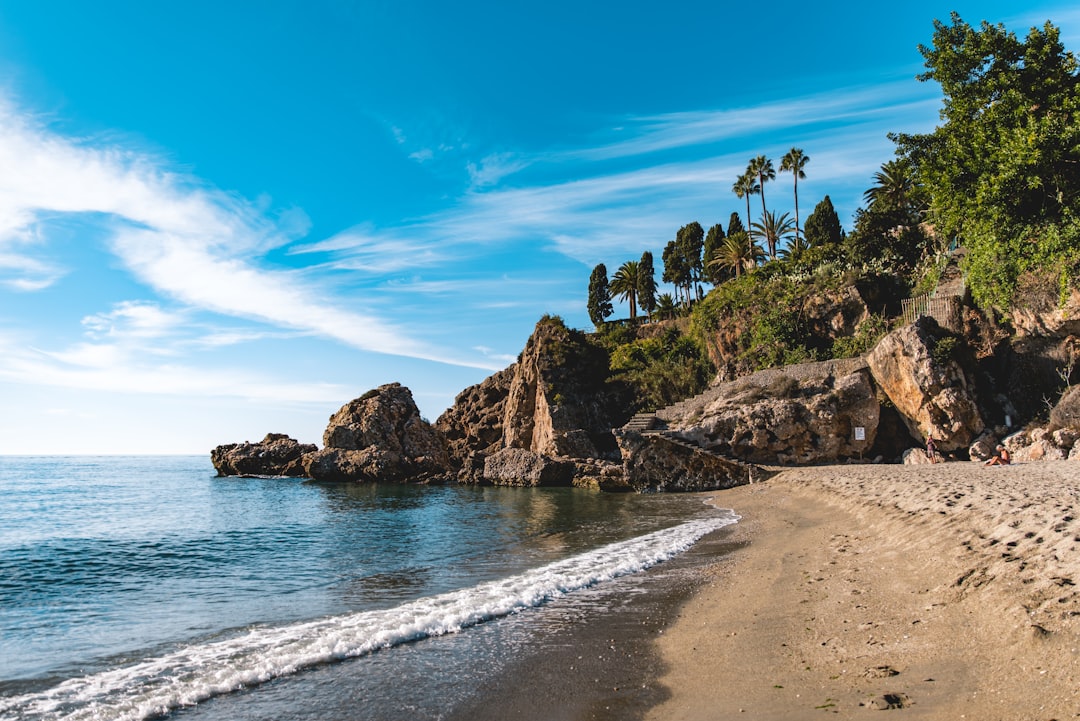
The old town clusters around the Balcón de Europa, a clifftop promenade that looks out over the Mediterranean. Below it, coves and beaches string along the coast in both directions. The Nerja Caves (Cuevas de Nerja), discovered in 1959, sit about 4 kilometres from the town centre and pull over half a million visitors a year, which tells you something about how established tourism is here.
Unlike many Costa del Sol resorts, Nerja has a functioning town centre with year-round residents, a daily market, a reasonable range of shops, and a social fabric that doesn’t entirely shut down in October. That matters if you’re planning to use a property outside peak summer season.
Where Is Nerja on the Costa del Sol?
This question trips up more than a few buyers. Nerja is on the eastern Costa del Sol, in a sub-region known as the Axarquía. It’s about 52km east of Málaga, not west toward Marbella. If you’re comparing it with Estepona or Fuengirola, you’re looking at a drive of 90-120 minutes between them, so the two areas serve quite different buyer profiles.
The nearest large town is Torre del Mar (around 22km west), and Vélez-Málaga (the regional capital of the Axarquía) is 25km away. Granada city is about 90 minutes north, which opens up day-trip options that the western Costa del Sol can’t offer.
Property Types in Nerja
Apartments make up the majority of what sells to British buyers. Two-bedroom units in established urbanisations like Capistrano, Verano Azul, or El Chaparil account for most transactions. These are typically 70-90 square metres, built in the 1970s-1990s, often with communal pools and gardens, and usually require some updating.
New builds are rare inside Nerja itself. The topography (the town is on a series of hills and cliffs) and tight planning controls mean large-scale development is largely impossible in the urban core. New construction exists on the outskirts, mainly toward Maro (4km east) or along the Nerja-Torrox corridor.
Townhouses and duplexes offer more space than apartments and are popular with buyers who want a garden or terrace. Expect three bedrooms and a private courtyard in the €250k-450k range depending on condition and proximity to the coast.
Villas with sea views sit at the top of the market and start at around €500,000 for a well-presented three-bedroom property. Front-line villas with direct cliff or beach access can exceed €2 million, and anything genuinely overlocking the Balcón de Europa commands a significant premium.
Rural fincas in the surrounding Axarquía hills are a different proposition entirely: genuine Spanish countryside at prices that can start under €200k, but with access challenges, agricultural water rights complexity, and renovation costs that buyers often underestimate. If you’re looking at these, budget for a proper architect’s survey (€800-2,500) and get your abogado to check the legal classification of the land before signing anything.
Property Prices in Nerja in 2026
Nerja has seen consistent price growth over the past three years, driven partly by post-pandemic demand for coastal properties with outdoor space, and partly by an increasing scarcity of available stock inside the town itself.
Typical price ranges as of 2026:
| Property type | Price range | Notes |
|---|---|---|
| Studio apartment | €110k-185k | Often in older urbanisations, small terraces |
| 2-bed apartment, inland/no view | €185k-290k | Capistrano, El Chaparil, Verano Azul |
| 2-bed apartment, sea view | €250k-420k | Significant premium for south-facing terrace |
| 3-bed apartment | €300k-550k | Well-located units over €400k |
| Townhouse/duplex | €220k-500k | Garden, more space than equivalent apartment |
| Villa with sea view | €500k-1.8m+ | Steep land, limited supply |
| Frontline/Balcón de Europa | €5,000+/m2 | Top-tier premium, very few come to market |
Average price per square metre across the town sits roughly at €2,600-3,500/m2 for standard apartments. Compare that with Estepona at €3,900-4,260/m2 or Marbella at €4,900-5,400/m2 and you get a sense of why value-conscious buyers are looking east.
That said, Nerja is not cheap by Axarquía standards. Inland villages like Frigiliana (8km) or Competa (25km) offer significantly lower prices, but with a completely different buyer profile and less liquidity.
Why British Buyers Keep Choosing Nerja
Several things make Nerja consistently attractive to UK buyers specifically.
The climate. Nerja sits in a natural sheltered amphitheatre that gives it one of the highest sunshine hours and mildest winters on the Costa del Sol. In January, daytime temperatures regularly reach 17-19 degrees. The town gets slightly more rainfall than the western Costa del Sol but the flip side is lush vegetation and a greener landscape.
An established British community. There’s a British Legion, English-language social groups, and enough British residents that you can find English-speaking professionals (estate agents, solicitors, accountants, healthcare providers) without difficulty. That said, Nerja remains genuinely Spanish in character. The old quarter functions in Spanish; integration with the local community is entirely possible.
The scale. Nerja is small enough to walk. The old town, the Balcón de Europa, and Playa Burriana are all within 20 minutes on foot. That’s unusual on the Costa del Sol, where car dependency is the norm.
Price relative to the western Costa del Sol. A two-bedroom apartment with a sea view that would cost €400k-500k near Marbella can be found in Nerja for €280k-380k. The gap has narrowed since 2020, but it persists.
A long tourist season. The mild climate means Nerja attracts visitors from March through November, which matters if you’re thinking about rental income. It’s not a pure summer resort.
The Balcón de Europa Neighbourhood
The central neighbourhood around the Balcón de Europa is the most prestigious and most expensive. Properties here are almost always in older buildings, often refurbished, and rarely appear on the open market. When they do, they sell fast. Expect to pay €4,000-6,000/m2 or more for anything genuinely walking distance from the promenade with a sea view.
If you want to be in this part of town, patience is more useful than a high budget. There are usually no more than a handful of properties available at any one time, and many transactions happen off-market through local agent networks.
Playa Burriana and the Coastal Strip
Playa Burriana (about 400 metres long and the town’s main beach) anchors the most popular residential area for British buyers. The apartments and townhouses east and west of Burriana sit within 10 minutes’ walk of both the beach and the town centre, making them the most practical buy for people who want convenience above all else.
Price per square metre in this strip falls broadly between €2,800 and €4,000/m2. The Capistrano urbanisation (large, well-established, with multiple pools, tennis courts, and a commercial strip) sits in this zone and accounts for a significant proportion of British-owned property in Nerja. It’s a good market for resale liquidity because there’s always demand from British buyers who’ve been coming to Nerja on holiday for years.
The Inland and Rural Areas Around Nerja
The mountains behind Nerja rise steeply and quickly. Frigiliana, the white village 8km inland, has its own small property market, mostly stone-built village houses and reformed farmhouses. Properties there start at around €180k for a one-bedroom village house in need of work and go to €600k+ for a large reformed finca with views.
For buyers willing to accept a drive for every errand, this area offers something quite different from the coastal apartment market: character, privacy, and views over both the coast and the Almijara mountains. But the practicalities are real: steep roads, no public transport to speak of, and summer temperatures significantly hotter than the coast.
Lifestyle in Nerja: What Day-to-Day Life Actually Looks Like
The Tuesday market in the Burriana area is probably the largest weekly event in the Nerja calendar, pulling both residents and visitors. A daily food market operates near the town hall throughout the week. Nerja has a Mercadona supermarket (standard; well-stocked), a local market, and enough specialist shops to manage basic supplies without driving to Vélez-Málaga.
The social calendar for British residents includes pub quiz nights, walking groups in the Axarquía hills, bridge clubs, and a reasonably active arts scene for a town of its size. If you’re the kind of person who likes a properly integrated local life, the town’s scale makes that achievable in a way that a large urbanisation outside Marbella simply doesn’t.
Winters are mild and the town is quiet from roughly December to February. Some restaurants and bars reduce their hours or close for a few weeks. If you need a buzzing social scene year-round, you should know this before buying.
Getting There: Transport and Connectivity
This is one of the honest conversations about Nerja. There is no railway line to Nerja. The nearest train station with useful connections is in Málaga city (52km away). There’s a regular coach service operated by Alsa from Málaga bus station to Nerja, taking about 1 hour 20 minutes and costing around €5. Coaches run roughly every hour during the day, less frequently in the evening.
By car from Málaga airport, Nerja takes 45-60 minutes depending on traffic, using the A-7 coastal road (free but slower) or the AP-7 toll motorway (faster; tolls around €6-8 each way). There’s no Cercanías suburban train service this far east.
Ryanair, easyJet and British Airways all fly direct to Málaga from multiple UK airports, so the flight connection is fine. The issue is the transfer from Málaga to Nerja, which is manageable (hire car, taxi, or airport shuttle) but takes more planning than properties closer to the airport.
For buyers who intend to visit frequently from the UK without driving, or for permanent residents without a car, the lack of a train is a genuine constraint. If you’re comparing Nerja with Fuengirola or Benalmádena (both on the Cercanías C1 line, 25-35 minutes from the airport), this matters.
Driving Times and Day Trips
One upside of Nerja’s eastern location: day trips to Granada (90 minutes), the Alhambra, and the unspoilt Alpujarras mountains are far more practical than from the western Costa del Sol. Nerja buyers regularly cite this as one of the unexpected lifestyle benefits.
From Nerja:
– Málaga city centre: 55-65 minutes by car
– Málaga airport: 45-60 minutes
– Torre del Mar / Vélez-Málaga: 20-25 minutes
– Granada city: 90 minutes
– Marbella: 1 hour 50 minutes – 2 hours
– Seville: approximately 3 hours
Schools Near Nerja
There are no international schools in Nerja itself. The nearest British-curriculum or bilingual international schools are in the Málaga city area, which is a significant daily commute.
Within 30-40 minutes by car, the Vélez-Málaga area has some state schools with bilingual programmes. For families who need an English-language international education, the options from Nerja are materially worse than from the western Costa del Sol, where multiple established international schools (Aloha College, Swans International School, ISE, EIC) operate within easy reach.
This is an important point to factor into your decision: Nerja is not ideal for families with school-age children who require English-language private schooling. For retirement buyers, holiday-home buyers, or families happy to use the Spanish state system, it’s less of an issue.
State primary (primaria) and secondary (secundaria) schools in Nerja itself are fine for full-time residents integrating into Spanish life. Spanish state schooling is free and generally well-regarded.
Healthcare in Nerja
Nerja has a public health centre (Centro de Salud) for registered residents and visitors holding a GHIC card. It handles GP appointments, routine care, and minor emergencies during opening hours.
The nearest hospital with full facilities is Hospital Comarcal de la Axarquía in Vélez-Málaga, approximately 25km (25-30 minutes by car). This is the main public hospital serving the eastern Costa del Sol and covers A&E, surgery, and specialist services.
For private healthcare, there are several English-speaking doctors in Nerja (general practice, dentistry, physiotherapy). For specialist private hospital care, most residents use Clínica HMC or Hospital Clínico Virgen de la Victoria in Málaga, which are 60-65 minutes away.
British buyers who plan to spend more than 183 days a year in Spain become tax residents and lose entitlement to NHS care. Before that point, GHIC covers urgent and medically necessary care in the Spanish public system. For anyone planning to move permanently, private health insurance is worth budgeting at €80-200 per person per month depending on age and provider. See our complete healthcare guide for British residents on the Costa del Sol for full details.
Beaches: What to Expect
Nerja’s beaches are the main selling point for many buyers, and they’re genuinely good: fine dark sand (volcanic, characteristic of this part of the coast), clear water, and good facilities.
Playa Burriana: the main beach, 400m long, with sunbeds, parasols, two beach restaurants (including the well-known Ayo’s, famous for large paella pans), watersports hire, and a consistently good Blue Flag record.
Playa Calahonda: smaller, rockier, accessed down steps from near the Balcón de Europa. More sheltered, usually quieter than Burriana.
Playa del Salon and Playa la Caletilla: small coves close to the town centre, popular with locals. Very limited facilities but great for a quieter swim.
Maro Beach (Playa de Maro): 4km east of Nerja, accessed down a narrow road. One of the most beautiful and natural beaches in the province. No sunbeds, no bars, no development. The protected status means it stays that way. Worth the drive.
Beach quality in summer is high but the beaches do get busy in July and August. Burriana in particular feels crowded at peak season. If you visit before mid-June or after mid-September, you’ll find them much more pleasant.
Golf and Leisure Near Nerja
Nerja itself has no golf course, which is a relevant fact for buyers comparing it with the western Costa del Sol. The nearest is Baviera Golf at Torrox Costa, around 12km west (about 15-20 minutes by car). It’s a well-regarded 18-hole course, playable year-round, with green fees roughly €40-75 depending on season.
For serious golfers, the western Costa del Sol with its 50+ courses within 30 minutes of Marbella is a completely different proposition. If golf is central to your lifestyle, this should weigh in your decision.
What Nerja offers instead: walking, hiking in the Axarquía hills and the Tejeda, Almijara and Alhama Natural Park (excellent trail network accessible from the town), cycling, diving, kayaking, and a generally outdoor pace of life that suits the landscape.
The Nerja Caves are worth mentioning as a leisure asset too: they hold concert events in their main chamber during summer that are genuinely unusual experiences.
Restaurants, Cafes and Nightlife
Nerja has a solid selection of restaurants covering most price points. The old town and Balcón de Europa area are where most of the quality independent places cluster.
El Pulguilla: long-established seafood restaurant near the waterfront, good for fresh fish and frituras (fried fish). Expect to pay €20-30 a head.
Pepe Rico: on Calle Almirante Ferrándiz, popular for its large terrace and reliable Spanish menu.
Ayo’s: the beach restaurant at Burriana, famous for paella cooked in enormous pans over wood fires. Very touristy but fun. Book ahead in summer.
There are enough good tapas bars to keep you occupied for months. The standard “menu del dia” (set lunch menu, two courses plus wine) runs €12-15 in Nerja, compared with £20-28 for equivalent food in the South East of England.
Nightlife is modest by Marbella or Fuengirola standards. There are bars open late in the old town through summer, and a small strip of clubs near the Capistrano area. It’s not somewhere you move for the nightlife. It’s somewhere you move because you want a genuine town and a proper beach, not a resort strip.
The Property Buying Process in Nerja
The buying process is the same as anywhere in Spain, but it’s worth flagging a few Nerja-specific practical points.
NIE number first. You cannot complete any property purchase in Spain without a Número de Identificación de Extranjero. Apply through the Spanish Consulate in London, or through a lawyer in Spain acting under power of attorney. See our NIE number guide for UK buyers for the full process.
Appoint an independent abogado. Don’t use the seller’s solicitor or a lawyer recommended by the developer. For Nerja specifically, make sure your lawyer checks the legal classification of any property on sloped terrain: some older villas and rural properties in the Axarquía area have planning irregularities or sit on agricultural-classified land. This is not unique to Nerja but the area’s topography makes it more common than on the flat coastal strips.
Budget for additional costs. On a resale property in Andalusia, the Impuesto de Transmisiones Patrimoniales (ITP, transfer tax) is 7% of the purchase price. Add notary fees (€600-1,500), Land Registry fees, and your abogado (1-1.5% of purchase price plus IVA). On a €300k apartment, budget roughly €30,000-35,000 on top of the purchase price for all costs combined.
Currency. If you’re buying with pounds sterling, consider a currency broker (Currencies Direct, Moneycorp, OFX) rather than your UK bank. The spread on bank foreign exchange on a €300k transfer can cost you £3,000-5,000 compared with a specialist broker. See our currency hedging guide for how forward contracts work.
The full step-by-step process for UK buyers in Spain is covered in our complete buying guide.
Off-Plan vs Resale in Nerja
As noted above, off-plan (new build) is rare in Nerja itself. Where new development does exist, it tends to be smaller-scale, often boutique apartment blocks on the town’s periphery or toward Maro. These projects typically attract a premium of 10-15% over equivalent resale units, reflecting the newer specification, energy efficiency ratings, and reduced maintenance requirements.
For most buyers in Nerja, the choice is resale. The main advantage of resale here is that you can see exactly what you’re getting, check the community fees, inspect the building, and often negotiate 5-8% below asking price in the current market. The stock of older apartments (1970s-1990s) in urbanisations like Capistrano is large enough to give you genuine choice.
If you’re looking at any property built before 2000, commission a structural survey from an independent architect registered with the Colegio de Arquitectos de Málaga. A good technical report costs €500-900 and can save you from buying into a building with unresolved structural or water ingress issues. It’s not legally required in Spain, but it should be standard practice.
Legal and Tax Notes for British Buyers
Post-Brexit, British buyers are treated as non-EU residents for the purposes of Spanish property law and taxation. Key points:
Non-resident income tax (IRNR / Form 210): If you own a Spanish property but don’t rent it out, you still owe an annual imputed income tax to the Spanish tax authority. The rate for UK non-residents is 24% on a calculated deemed rental income (typically 1.1% of the cadastral value). For a property with a cadastral value of €120,000, this works out at roughly €317/year. It needs to be filed annually (Form 210) even if you owe a small amount. See our Form 210 guide for filing deadlines and how to do it.
Inheritance tax: Andalusia applies a 99% reduction in inheritance tax for spouses and direct descendants (Groups I and II), which largely neutralises what was historically a significant concern. A Spanish will is strongly recommended regardless. See our Spanish inheritance tax guide for the full picture.
Capital gains: If you sell a Spanish property as a non-resident, Spanish CGT applies at 19% for EU residents but 19% for UK nationals too (confirmed post-Brexit for capital gains, though the non-resident rental rate is 24%). At the point of sale, the buyer is required to withhold 3% of the purchase price and pay it to the tax authority on your behalf (Form 211). Your abogado will handle the offsetting process.
Annual costs to budget for: IBI (local property tax, €200-700/year depending on cadastral value), community fees (€50-150/month for a standard Nerja apartment, up to €250-300 for a more upscale urbanisation), home insurance (€200-500/year), gestoría (€400-800/year to handle Form 210 and other filings), and utilities (electricity, water: €800-1,500/year for a holiday home used 6-12 weeks per year).
Rental Investment Potential
Nerja is one of the stronger rental markets on the eastern Costa del Sol, and it performs well for UK buyers specifically because British tourists continue to choose Nerja in large numbers. Searches for “Nerja holiday accommodation” from the UK show consistent year-on-year demand, and the town’s scale means it doesn’t feel like an anonymous resort.
Short-let yields: A well-located 2-bedroom apartment in Capistrano or near Burriana, managed professionally, can generate €18,000-28,000 per year in gross rental income. That’s a gross yield of roughly 5-8% on a €280k-350k property. Net yield (after platform fees, management fees typically 20-25%, running costs) is typically 3-5% for a well-run short-let. These numbers assume 20-26 weeks of occupancy, which is achievable but not guaranteed.
Long-let yields: If you prefer a stable income from a long-term tenant (12-month contract), expect gross rents of €700-1,100/month for a 2-bed apartment, giving a gross yield of 3.5-4.5%. Lower maintenance headaches, but lower income.
Tourist licence: To operate a short-let legally in Andalusia, you need a Vivienda con Fines Turísticos (VFT) licence from the Junta de Andalucía. The application goes through the DUCA portal. Getting the licence requires a habitation certificate (cédula de habitabilidad), a property with no prior VFT licence issues, and compliance with minimum facilities requirements. Budget 4-8 weeks for the process. Without a valid VFT licence, fines for illegal short-letting run to €18,000-150,000 under Andalusia’s tourism law.
Before buying for rental, verify that the building’s community statutes allow tourist rentals. Some older Nerja communities have voted to prohibit VFT licences in their buildings, and these decisions are legally enforceable.
Working with a Property Agent in Nerja
Nerja has both international agencies and local Spanish agencies. The international ones are more likely to have English-speaking staff and experience dealing with British buyers, which matters for paperwork and process explanation. The local Spanish agencies sometimes have better access to properties that never reach the international portals.
One thing to watch: the Spanish property market still operates extensively on multi-listing with variable commission structures. An asking price from one agent may be different from the same property listed through another. Your abogado should be running a nota simple (Land Registry extract) on any property before you sign anything, which confirms the actual owner, any existing debts or charges against the property, and the registered dimensions.
At My Spanish Property Finder, we work across the Costa del Sol including the eastern areas around Nerja. Rather than being tied to one agency’s stock, we connect you with properties across multiple sources, which means you’re less likely to overpay or miss something that matches your brief. Get in touch here and tell us what you’re looking for.
FAQs: What British Buyers Ask About Nerja
Is Nerja good for British buyers?
Yes, consistently. Nerja has one of the largest proportionate British communities on the eastern Costa del Sol, a well-established market, good English-speaking professional services, and prices that compare favourably with the western Costa del Sol. The main considerations are the transport situation (no train, 45-60 minutes from the airport) and the limited international school options.
What are property prices in Nerja in 2026?
Standard two-bedroom apartments in urbanisations like Capistrano range from €185,000 to €290,000 for inland/pool-view units, and €250,000 to €420,000 for sea-view properties. Villas with sea views start at around €500,000 and rise well above €1 million for front-line positions near the Balcón de Europa. The average price per square metre across the town runs at roughly €2,600-3,500/m2, making it noticeably more affordable than Marbella or Estepona.
How far is Nerja from Málaga airport?
By car, 45-60 minutes depending on traffic and whether you take the AP-7 toll motorway or the free A-7 coastal road. There is no direct train or tram from the airport to Nerja. Coach transfers take about 1 hour 20 minutes from Málaga bus station. For frequent visitors from the UK, hiring a car at the airport is the most practical arrangement.
What rental income can I expect from a Nerja property?
A well-located two-bedroom apartment run as a holiday let can generate €18,000-28,000 in gross annual rental income, assuming 20-26 weeks of occupancy. Net yields after management fees, platform costs, and running expenses typically land at 3-5%. You must hold a valid Junta de Andalucía VFT tourist licence to operate legally, and you should check the building’s community statutes permit tourist rentals before buying.
Are there British schools in Nerja?
No international schools operate in Nerja itself. The nearest English-language international schools are in the Málaga city area, about 55-65 minutes by car. For families with school-age children requiring an English-curriculum education, this is a significant practical constraint. Nerja is better suited to retirees, couples without school-age children, and holiday-home buyers.
What is the best area of Nerja to buy in?
It depends on your priorities. The Balcón de Europa old town is the most prestigious but has very limited supply and the highest prices. The Burriana-Capistrano belt offers the best combination of beach access, convenience, and resale liquidity. Maro (4km east) offers lower prices, more space, and a more rural feel with access to the best natural beach in the area. For buyers on a tighter budget, inland properties east of the town toward Frigiliana offer more for less, with the trade-off of needing a car for everything.
What taxes do British buyers pay when buying in Nerja?
On a resale property, ITP (Impuesto de Transmisiones Patrimoniales) is 7% of the purchase price in Andalusia. On a new build, you pay IVA at 10% plus AJD (stamp duty) at 1.2%. Both are paid at completion. Annual costs include IBI (local property tax), Form 210 imputed income tax if not renting, community fees, and home insurance. For full details, see our buying guide and Form 210 guide.
Your Next Steps
Nerja rewards buyers who do their research properly. The prices are real, the lifestyle is real, and the British community that’s been here for 30+ years is a reliable signal that this is a well-tested destination. The transport and school situation are genuine constraints that matter for some buyers and not at all for others.
If Nerja feels like the right fit, the practical first steps are:
- Get your NIE number sorted before anything else (it takes 4-12 weeks from the UK).
- Set a realistic budget including all purchase costs (add 12-14% on top of the property price for taxes, fees, and legal costs).
- Appoint an independent English-speaking abogado in the Nerja area before signing any reservation document.
- Visit the town in October or November, not August, to see what the off-season actually looks like.
- Talk to us. We can point you toward the right properties and the right professionals.
If you’re ready to start looking, or you just want to understand whether Nerja is the right fit for your plans, get in touch with our team here. We’re happy to have a no-obligation conversation about what you’re looking for and whether the eastern Costa del Sol makes sense for you.