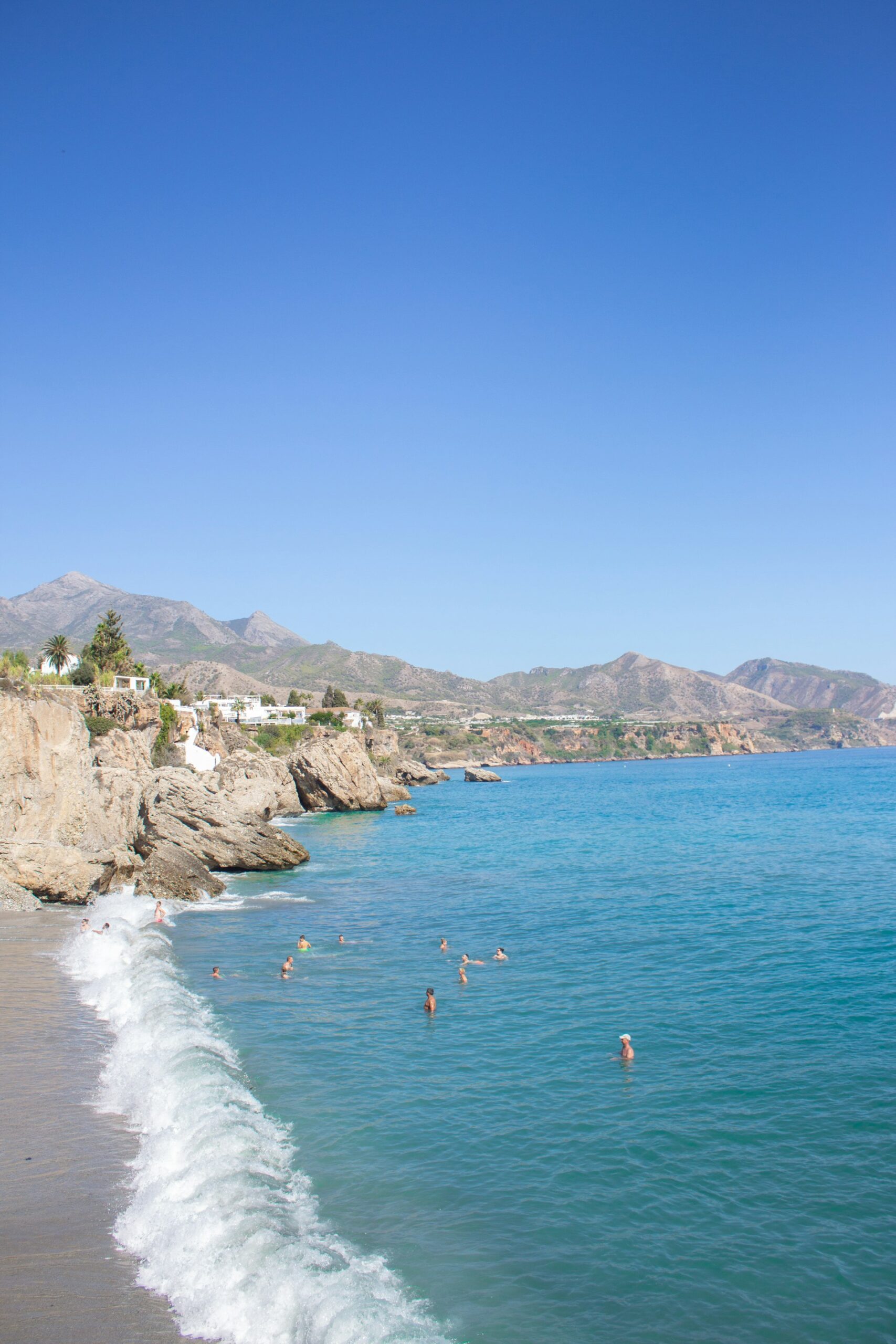
A British couple I was helping last year nearly drove straight past Calahonda. They’d been looking at Marbella and Fuengirola, assumed anything in between was “just more of the same”, and were ready to book a second viewing trip before I suggested a detour. Twenty minutes later they were sitting on a beachfront terrace watching the Mediterranean turn gold in the afternoon light, and within six weeks they’d exchanged on a three-bedroom townhouse for €265,000. That doesn’t happen in Marbella at that budget.
Calahonda sits roughly halfway between Fuengirola and Marbella, tucked into a gentle curve of the Costa del Sol coastline in the Mijas municipality. It is not the flashiest place on the coast, and it doesn’t try to be. What it offers instead is something genuinely harder to find: affordable access to a sun-drenched Mediterranean lifestyle, a well-established British community, and property prices that still leave room for a proper return on investment.
This guide covers everything a British buyer needs to know: prices, neighbourhoods, lifestyle realities, transport, schools, golf, healthcare, rental potential, and the buying process. No estate agent speak. Just the facts.
Where Is Calahonda? A Quick Orientation
Calahonda lies on the N-340 coastal road and the AP-7 motorway corridor, approximately 30 kilometres west of Málaga city centre. It sits within the Mijas municipality (Málaga province), though you will sometimes see it listed under Mijas Costa. Fuengirola is about 12 kilometres to the east; Marbella is roughly 20 kilometres to the west.
The area is often described as Mijas Costa’s eastern anchor, blending into a string of urbanisations that run along this stretch of coast. Unlike the purpose-built resort towns of Torremolinos or the old-money prestige of Marbella, Calahonda grew organically from the 1970s onward as a residential retreat for Northern European buyers who wanted sun and sea without the price tag to match.
The result is a place that feels lived-in rather than performed: proper supermarkets, working health centres, year-round resident communities, and a pace of life calibrated to people who actually live here rather than those passing through for a fortnight.
The Neighbourhoods of Calahonda
Calahonda is not one single place but a loose collection of urbanisations and sub-areas spread across the hillside above the coast. Understanding the distinctions helps enormously when searching for property.
Sitio de Calahonda is the main hub: the commercial centre with shops, bars, restaurants, a health centre, a pharmacy, and the bulk of the established apartment complexes. If you want walkability and community feel, this is where to start looking.
Calahonda Playa refers to the lower, beachfront strip where frontline apartments command a premium of 20-35% over equivalent inland properties. Demand is strong and stock is limited, so good beachfront units at realistic prices move quickly.
Riviera del Sol sits adjacent to Calahonda to the east and shares much of the same infrastructure. Prices are marginally lower here than in Sitio de Calahonda proper, and the apartment complexes tend to be slightly larger. Many buyers treat Riviera del Sol and Calahonda as interchangeable, and for practical purposes they largely are.
El Chaparral lies slightly west of Calahonda, closer to Mijas Costa, and is best known for Chaparral Golf Club. Property here skews toward larger villas and detached houses, and it attracts a slightly different buyer profile: golfers and families who want more space and privacy.
Property Types Available in Calahonda
The market is dominated by apartment complexes, most of which were built between the late 1970s and the early 2000s. These are typically two- or three-bedroom units arranged around communal pools, with underground parking and sea views from upper floors. Quality varies considerably: some complexes are immaculately maintained by active residents’ committees, while others have suffered from years of absentee ownership and deferred maintenance. A pre-purchase survey matters here more than in newer developments.
Townhouses and semi-detached properties make up the next largest segment. Many are arranged in small gated communities of 10-30 units, often with private garden space and a communal pool. These appeal particularly to families and buyers who want more outdoor space than a standard apartment provides.
Detached villas exist in Calahonda but are less common than in areas like Benahavís or Nueva Andalucía. Most sit on plots of 500-1,200 square metres, with private pools and three or four bedrooms. The majority were built in the 1980s and 1990s and will need varying degrees of updating.
New-build supply in Calahonda itself is limited. There are some boutique developments on the remaining plots above the coastal road, but unlike Estepona or the New Golden Mile, Calahonda is predominantly a resale market. That is both a constraint and an opportunity: you can negotiate on price in a way you cannot with off-plan developers.
Calahonda Property Prices in 2026
Calahonda occupies the affordable-to-mid-range bracket on the Costa del Sol price spectrum. Typical asking prices in 2026 are as follows:
- Studio apartments: €75,000-€120,000
- One-bedroom apartments: €110,000-€180,000
- Two-bedroom apartments: €155,000-€280,000 (frontline beach: €220,000-€380,000)
- Three-bedroom apartments: €210,000-€380,000
- Townhouses (3 bed): €220,000-€450,000
- Detached villas (3-4 bed): €350,000-€900,000+
On a price-per-square-metre basis, expect to pay approximately €2,000-€3,200/m² for most apartments in Sitio de Calahonda and Riviera del Sol. El Chaparral villas and beachfront properties sit at the upper end of that range and occasionally above it. For context: Fuengirola runs at €3,200-€5,300/m² on the seafront, Marbella averages €4,900-€5,400/m², and Estepona sits at €3,900-€4,260/m² (Colegio de Registradores, Q1 2026). Calahonda represents a genuine price advantage over all three.
Negotiation room on resale properties is typically 5-10% below the asking price, more on properties that have been on the market for six months or longer. As with any Spanish resale purchase, check the property’s legal status carefully before making any offer: whether the property matches its registered description, that there are no outstanding debts on the community fees, and that the occupation licence (cédula de habitabilidad) is current.
Why British Buyers Choose Calahonda
The answer, in most cases, is value. A budget of €200,000-€300,000 buys a comfortable two- or three-bedroom property close to the beach in Calahonda. The same budget in Marbella or Puerto Banús gets you a studio, if you’re lucky, or a two-bed a long walk from the coast.
But price is only part of the story. Calahonda has one of the longest-established British communities on the Costa del Sol. The first wave of British buyers arrived in the 1970s and 1980s, and many stayed. Their children and grandchildren often own properties here too. The result is a place where English is genuinely useful in daily life: most estate agents, restaurants, health professionals, and local businesses are geared toward English-speaking residents.
The area also lacks the extremes that put some buyers off other Costa del Sol locations. It is not as hectic as Torremolinos in summer, not as remote as Casares Costa in winter, not as expensive as Marbella at any time of year. It has enough year-round infrastructure to feel like a proper place to live, not just a holiday park.
The British Community in Calahonda
Walk through Sitio de Calahonda on a Tuesday morning in October and you’ll hear more English than Spanish. The local branch of the International Church serves a congregation drawn from across a dozen nationalities but skewed heavily British. There are English-language book swaps, walking groups, and residents’ associations that conduct their meetings primarily in English.
This can be a draw or a deterrent depending on what you’re looking for. If you want rapid integration into Spanish life and language immersion, Calahonda is probably not your best option. If you want community, familiar social rhythms, and the ability to navigate daily life without significant language anxiety while you get settled, it is one of the best-established British enclaves on the entire coast.
The community is notably mixed in terms of age and intention. Retirees who have been here for twenty years sit alongside younger remote workers who arrived post-Covid and families who came for the schools. The year-round population is higher than in many comparable Costa del Sol urbanisations, which means the place has genuine life outside the summer peak.
Lifestyle and Day-to-Day Living
Day-to-day life in Calahonda revolves around a well-established strip of amenities in and around Sitio de Calahonda. There are several supermarkets including a Mercadona and a Lidl within a short drive, a weekly market, pharmacies, banks, and a reliable selection of bars and restaurants ranging from full-English breakfast cafés to decent Spanish restaurants serving proper menú del día for €12-15.
The pace in winter is notably slower: some seasonal businesses close from November to February, and the population contracts. But the core infrastructure stays open, and many longer-term residents regard the off-season as the best part of the year: uncrowded beaches, mild temperatures (average 17-19°C in January), and a quiet that the summer months cannot provide. In July and August, the population swells considerably and the roads and beaches become considerably busier.
For anything beyond everyday basics, the nearest larger centres are Fuengirola (12 km east) and La Cañada Shopping Centre in Marbella (about 20 km west). Both are accessible by car in 15-20 minutes outside rush hour. Málaga city, with its Picasso Museum, historic centre, and full urban amenity set, is under 40 minutes by the AP-7 motorway.
Transport and Connectivity
This is where the honest answer matters. Calahonda does not have a railway station. The C1 cercanías line from Málaga stops at Fuengirola, not Calahonda, which means you need a car to get to the train, or you rely on the local bus service (line 120 Fuengirola-Marbella runs regularly but slowly along the coastal road). If you are planning to live here without a car, think carefully.
With a car, the picture looks considerably better. The AP-7 (toll motorway) and A-7 (free coastal route) both run through the area. Málaga Airport (AGP) is 35-40 minutes door to door in normal traffic, closer to 50-60 minutes in summer peak periods. The airport serves over 30 direct UK routes, with year-round flights from London Gatwick, Heathrow, Stansted, Manchester, Birmingham, Bristol, and Edinburgh, among others.
Fuengirola, reachable in 15-20 minutes by car, has the cercanías station giving onward connections to Málaga city and the airport. For regular commuters or frequent travellers, a car plus Fuengirola’s train connection covers most practical transport needs.
The AP-7 toll from the Mijas Costa exit to Málaga Airport runs approximately €5-7 each way. Most residents factor this into their transport calculations. The A-7 free route is an option but adds 15-20 minutes in traffic.
International Schools Near Calahonda
Calahonda does not have an international school within the urbanisation itself. The nearest options are a short drive away and cover the main British curriculum families typically want:
- St. Anthony’s College (Mijas Costa, approximately 10 minutes): British-style curriculum, well established, popular with British families across the Mijas Costa and Calahonda corridor. Fees from approximately €4,800-€8,500 per year depending on year group.
- Colegio Internacional de Mijas (CIM) (Mijas Costa, 12 minutes): IB and Spanish bachillerato. Smaller and more international mix than St. Anthony’s. Fees from approximately €5,500-€9,000 per year.
- Aloha College (Nueva Andalucía, 25 minutes): British curriculum GCSE and A-Level, well-regarded results, larger senior school. Fees from approximately €7,200-€11,500 per year. A reasonable option for families already considering the Marbella area.
- Swans International School, Estepona (30-35 minutes): British National Curriculum, small class sizes, popular with buyers on the western stretch. Less convenient from Calahonda than the Mijas options but worth knowing about.
Spanish state schools in the area are free and have improving English-language provision, but full immersion Spanish schooling is a significant step for children who arrive without the language. Most British families arriving with school-age children start at one of the international schools listed above and transfer to state if and when the children are ready.
Healthcare in Calahonda
Calahonda has a Centro de Salud (health centre) in Sitio de Calahonda providing GP-level primary care under the Spanish public system. Residents registered on the padrón (local census) with valid residency status can access this system. British buyers who have applied for Spanish residency and hold an S1 form from HMRC (for state pensioners) or private health insurance can use this.
For hospital-level care, the two most relevant private hospitals are:
- Hospital Vithas Xanit Internacional (Benalmádena, approximately 20 minutes): Well-regarded private hospital with English-speaking staff, full surgical and diagnostic facilities. Popular with British expats across the central Costa del Sol.
- Clínica HC Marbella (Marbella, 25 minutes): Private hospital, English-speaking team, good for specialist referrals in the Marbella direction.
Private health insurance for a healthy 55-year-old starts at approximately €80-120 per month through providers such as Sanitas, Adeslas, or Asisa. For buyers over 65, expect €150-250 per month. The Non-Lucrative Visa requires evidence of private health insurance with no copayments as a condition of approval, so this cost is in any case unavoidable for that visa route.
Dentistry in Calahonda and the surrounding area is well served by private clinics, the majority of which offer English-speaking staff. Costs are significantly lower than in the UK: a standard check-up and clean typically runs €40-60, and routine dental work tends to be 40-60% cheaper than NHS private rates.
Golf and Leisure
Calahonda sits in one of the most golf-dense zones on the entire Costa del Sol. Within a 20-minute drive, buyers have access to:
- Chaparral Golf Club (El Chaparral, 5 minutes): 18-hole parkland course with sea views, green fees approximately €35-55, popular with residents as a members’ club alternative.
- Miraflores Golf (Riviera del Sol, 10 minutes): 18-hole course, green fees from €30, well maintained and accessible. Popular with Calahonda and Riviera del Sol residents.
- La Cala Golf Resort (Mijas, 20 minutes): Three 18-hole courses (America, Asia, Europa), golf academy, hotel, and driving range. One of the best all-round golf facilities on the Costa del Sol. Green fees from €60-95 depending on course and season.
- Calanova Golf Club (La Cala de Mijas, 15 minutes): Compact 9-hole course, popular with beginners and casual players. Green fees from €30.
Beyond golf, the leisure offer includes water sports (jet ski and pedalo hire from the beach), hiking in the Mijas hills behind the coast, padel tennis at several clubs in the area, and regular sailing and motorboat excursions from Fuengirola marina.
Beaches
Calahonda has direct access to several beaches along its stretch of coast. Playa de Calahonda and Playa del Chaparral are the main ones: both are Blue Flag standard, reasonably well-maintained, and far less crowded than the beaches in Fuengirola or Marbella during peak season because the area lacks the package-holiday hotel density of those towns.
In summer (July-August), the beaches do fill up, particularly at weekends when day-trippers arrive from Málaga and Fuengirola. But on a Tuesday in June or a Saturday in October, you can find a comfortable patch without much effort. For buyers who prioritise beach access and genuine coastal living without extreme summer crowds, Calahonda is a better bet than most of its more famous neighbours.
The water quality along this stretch of coast is consistently good. Sea temperatures are swimmable from May through October, peaking at around 24-26°C in August and September.
Restaurants and Nightlife
Calahonda is not a nightlife destination. If that’s a priority, you’d be better served by Fuengirola or Marbella. What it does have is a solid selection of everyday eating options catering to year-round residents rather than seasonal tourists.
In and around Sitio de Calahonda, reliable options include several chiringuitos (beach bars) serving fresh fish and grilled meat at reasonable prices, a handful of British-style pubs for those who want that, and a growing number of Spanish restaurants offering genuine menú del día at €12-15 per person including wine. Quality has improved noticeably over the past decade as the year-round population has grown and demanded better.
Fuengirola’s wider restaurant scene is 15-20 minutes away and offers considerably more variety, including a good range of international restaurants, a lively evening port area, and a night market in summer. Marbella, in the opposite direction, has Old Town restaurants and the full Puerto Banús dining circuit if you want occasional access to something more upscale.
For everyday socialising, most British residents gravitate toward a combination of home entertaining, beach barbecues in season, and the local pub and bar scene. The community aspect of Calahonda means there is always something going on if you want to find it: pub quizzes, charity events, walking clubs, book groups.
The Property Buying Process in Calahonda
The process of buying a property in Calahonda follows the same path as any other Spanish purchase. The key steps are:
- Get your NIE number before you commit to anything. This tax identification number is required for every legal transaction in Spain, including property purchase. You can apply at a Spanish consulate in the UK before you fly, or through a lawyer in Spain. Allow 2-4 weeks via the consulate route, or 1-2 weeks if applying in person in Spain with a gestor.
- Instruct a Spanish property lawyer before signing any document. In Calahonda’s predominantly resale market, due diligence matters enormously: the lawyer will check the Nota Simple (Land Registry extract), verify there are no outstanding mortgages or debts on the property, confirm the community fee status, and check the cédula de habitabilidad.
- Reservation and Contrato de Arras: Once you have agreed a price and the due diligence is satisfactory, you pay a reservation deposit (typically €3,000-€6,000) to take the property off the market, followed by the private purchase contract (contrato de arras penitenciales) at which point you pay 10% of the agreed price. If you pull out, you lose the deposit. If the seller pulls out, they owe you double.
- Completion at the notary: The final escritura de compraventa (title deed) is signed before a Spanish notary, the balance is paid, and keys are handed over. This typically happens 4-12 weeks after the arras.
For a step-by-step walkthrough of the full process, see our complete guide to buying property in Spain as a UK citizen.
Off-Plan vs Resale in Calahonda
Calahonda is overwhelmingly a resale market. New-build supply is limited to a handful of boutique developments on the last remaining plots, and these tend to sell quickly when they come to market.
For most buyers in Calahonda, the choice is between different resale properties rather than between off-plan and resale. This has several practical implications:
- You pay ITP (Property Transfer Tax) at 7% of the purchase price rather than IVA + AJD (11.2%) on new builds. On a €220,000 purchase, that is €15,400 in ITP versus €24,640 in IVA+AJD – a meaningful difference.
- You can view exactly what you are buying, rather than relying on developer renders.
- You may need to budget for updating kitchens, bathrooms, or structural elements, particularly in properties built in the 1980s and 1990s.
- Resale transactions typically complete in 6-12 weeks rather than the 12-36 months common in off-plan.
If you specifically want a new-build on the Costa del Sol, areas like Estepona, the New Golden Mile (San Pedro-Estepona corridor), and the Benahavis foothills offer considerably more off-plan supply. For Calahonda buyers, the resale market is almost certainly the right focus.
Legal and Tax Notes for British Buyers
Post-Brexit, British buyers are classified as non-EU nationals for Spanish property purchase purposes. The practical implications are:
- Purchase taxes: No change. British buyers pay the same ITP (7% Andalusia) on resale or IVA+AJD (11.2%) on new-builds as anyone else. No additional surcharge for non-EU nationals.
- Mortgage LTV: Spanish banks typically offer non-residents 60-70% LTV rather than the 80%+ available to Spanish residents. You need a larger deposit as a result.
- Annual non-resident tax (Form 210): If you are not a Spanish tax resident and you leave the property empty or rent it on a short-term basis, you must file a Form 210 tax return annually. Imputed income (renta imputada) is calculated at 1.1% or 2% of the cadastral value, taxed at 24% for UK nationals post-Brexit. On a €220,000 property with a cadastral value of roughly €110,000, this typically works out at €220-320 per year. A gestor handles this for €150-300 per year. See our Form 210 guide for a full breakdown.
- Capital gains tax: If you sell, you pay 19% IRNR on any gain, and the buyer is required to withhold 3% of the sale price at completion as a tax deposit. You then claim back the overpayment within four months. Always notify a lawyer in advance of sale.
- NIE number: Required for every legal and financial transaction in Spain. You cannot sign any contract, open a bank account, or complete a property purchase without one. See our NIE guide for the full application process.
Tax rules change. Always verify current rates with a qualified Spanish tax adviser before completing any transaction.
Rental Investment Potential
Calahonda is a credible rental market, with decent yields by Costa del Sol standards. British buyers using property as a part-time holiday home and renting out when not in residence are common here, and there is established demand from both short-let tourists and longer-term tenants.
Short-let (tourist rental): A two-bedroom apartment in Sitio de Calahonda in good condition can achieve gross weekly rates of €600-€1,100 in high season (July-August) and €350-€600 in mid-season (May-June, September-October). An achievable gross annual return before costs and tax is approximately 5-6.5% on current purchase prices. After management fees (typically 20-30% of gross rental income), VFT licence costs, cleaning, maintenance, and Form 210 tax, net yields for UK non-residents tend to come in at 2.5-4%.
Long-let (residential rental): A two-bedroom apartment in good condition achieves €800-€1,100 per month in the current market. A three-bedroom townhouse runs €1,100-€1,600. Long-let yields on a gross basis are typically 4.5-5.5%, with net returns slightly higher than short-let once you factor out the management overhead and seasonal void periods.
Tourist licence requirement: Short-let rental in Andalusia requires a VFT (Vivienda con Fines Turísticos) licence from the Junta de Andalucía. Not all properties qualify: urban apartments in certain zones face restrictions. Always check the licence status of a property before buying with rental income in mind. Fines for unlicensed tourist rental run from €2,001 to €18,000. Our guide to renting out Spanish property covers the full process.
Working With a Local Agent in Calahonda
The Calahonda market has a mix of local Spanish agents, international franchise agencies, and small independent firms run by long-term British residents. The area’s established expat community means there are plenty of English-speaking options.
A few things worth knowing before you engage an agent:
- Most Costa del Sol agencies operate on an open-listing system, meaning the same property can appear across multiple agencies. This creates duplication online and occasionally price inconsistencies. Verify the actual asking price directly with the seller’s instructing agent.
- Buyer representation is still uncommon in Spain. You can instruct a buying agent to act specifically for you, but most buyers deal directly with selling agents. Make sure your lawyer (not your agent) is running the due diligence.
- Estate agent commission is typically paid by the seller, not the buyer, at 3-6% plus IVA. As a buyer, you should not be paying additional agency fees unless you have specifically engaged a buyer’s agent on a fee basis.
At My Spanish Property Finder, we work differently to the standard Costa del Sol estate agent. We take a brief from you, identify properties across multiple agencies and off-market sources, and make introductions directly – without tying you to a single agency’s listings. Tell us what you’re looking for and we’ll put together a shortlist.
Calahonda vs Nearby Areas: How It Compares
Buyers often consider Calahonda alongside Mijas Costa, Fuengirola, and La Cala de Mijas. Here is an honest summary of how they differ:
- Calahonda vs Fuengirola: Fuengirola is a proper town with a railway station, a large market, and a much wider retail and restaurant offer. Calahonda is quieter, more residential, and considerably cheaper per square metre. If you want urban convenience, Fuengirola wins. If you want tranquillity and value, Calahonda is the better call.
- Calahonda vs Mijas Costa: These areas overlap significantly. Mijas Costa is the broader administrative district; Calahonda is one of its urbanisation clusters. Prices and lifestyle are broadly similar. La Cala de Mijas (within Mijas Costa) has a more distinct village character and slightly stronger tourist traffic.
- Calahonda vs Marbella: The comparison most buyers make. Marbella offers more prestige, better restaurants, stronger capital growth in the prime market, and considerably higher prices. Calahonda offers value, community, and realistic budget for buyers who cannot or do not want to stretch to Marbella pricing. They are serving fundamentally different budgets and intentions.
For a deeper comparison of the Mijas Costa area, including La Cala de Mijas and the surrounding urbanisations, see our dedicated Mijas Costa guide. If Fuengirola is also on your radar, our Fuengirola property guide covers that market in full.
Calahonda’s Long-Term Property Market Outlook
Calahonda is not a high-growth market in the way that prime Marbella or the Estepona New Golden Mile are. Capital appreciation here tends to track the broader Costa del Sol mid-market rather than the headline-grabbing numbers from the luxury end. Over the five years from 2020 to 2025, the Mijas municipality saw average price growth of approximately 35-45% (INE data), consistent with the broader Costa del Sol trend but not exceptional by comparison with the western corridor.
The structural argument for long-term value is solid: limited new-build supply in an established urbanisation, consistent UK buyer demand supported by direct flight connectivity from major UK airports, and a year-round resident population that keeps the area economically active. What Calahonda is not going to give you is rapid short-term capital gains. For that, you’d need to look at prime Estepona, the Golden Mile, or off-plan developments in undersupplied areas.
For buyers prioritising lifestyle over pure investment returns, Calahonda is a genuinely well-suited option. For those primarily targeting maximum capital appreciation, it sits behind the western growth corridor in the current market.
Frequently Asked Questions About Calahonda Property
How much does property cost in Calahonda?
In 2026, two-bedroom apartments in Calahonda typically sell for between €155,000 and €280,000, with frontline beach units reaching €380,000 or more. Three-bedroom townhouses run from approximately €220,000 to €450,000. On a price-per-square-metre basis, expect €2,000-€3,200/m² for the majority of resale apartments. Detached villas start at around €350,000 and go well above €800,000 for the better-positioned, larger properties.
Is Calahonda a good investment for rental income?
Calahonda offers realistic rental yields for buyers who approach it sensibly. Short-let gross yields of 5-6.5% are achievable on well-located apartments; net yields after management costs and tax typically come in at 2.5-4% for UK non-residents. Long-let gross yields of 4.5-5.5% with lower management overhead are a credible alternative. A tourist licence (VFT) is required for short-let rental. Check licence eligibility before purchasing with rental income as a primary objective.
How far is Calahonda from Málaga Airport?
Calahonda is approximately 35-40 minutes from Málaga Airport (AGP) via the AP-7 motorway in normal traffic conditions. In peak summer traffic, allow 50-60 minutes. Málaga Airport has year-round direct routes to over 30 UK airports including London Gatwick, Heathrow, Stansted, Manchester, Birmingham, Edinburgh, and Bristol.
Are there international schools near Calahonda?
The nearest international schools are St. Anthony’s College and Colegio Internacional de Mijas (CIM), both in Mijas Costa and approximately 10-12 minutes from Sitio de Calahonda by car. Both offer English-medium education. Aloha College in Nueva Andalucía (about 25 minutes) is a well-regarded British curriculum school with strong GCSE and A-Level results. There are no international schools within Calahonda itself.
Do I need an NIE number to buy property in Calahonda?
Yes. An NIE (Número de Identificación de Extranjero) is required for all Spanish property transactions, whether you are buying, selling, or signing any legal document. You cannot complete a purchase, open a Spanish bank account, or register a utility in your name without one. You can apply at a Spanish consulate in the UK before you travel, or through a Spanish lawyer once you are in Spain. See our NIE guide for the full application process and timelines.
Can British buyers still purchase property in Calahonda after Brexit?
Yes. Brexit has not changed British citizens’ legal right to purchase property in Spain. The process is essentially identical to pre-Brexit. What has changed is that British buyers are now classified as non-EU nationals for mortgage LTV purposes (banks typically offer 60-70% rather than 80%+), and for non-resident income tax purposes (24% rate rather than the 19% rate that applied to EU residents). You also fall under the 90/180-day rule for time spent in Spain if you are not a Spanish resident. None of this prevents purchase; it is just context you need to plan around.
Ready to Start Your Calahonda Search?
Calahonda rewards buyers who are willing to do their homework rather than just follow the crowd to the usual Costa del Sol names. The prices are realistic, the community is genuinely welcoming, and the lifestyle on offer from a two-bedroom apartment at €200,000 is something you simply cannot replicate in southern England at any price.
If you’d like a shortlist of currently available properties in Calahonda matched to your budget and requirements, including off-market options our network sees before they’re listed publicly, get in touch. We work across multiple agencies and introduce buyers directly to sellers, so you get a complete picture of what is actually available rather than a single agent’s inventory.
Browse properties for sale in Calahonda or tell us what you are looking for and we will put together a tailored shortlist within 24 hours.