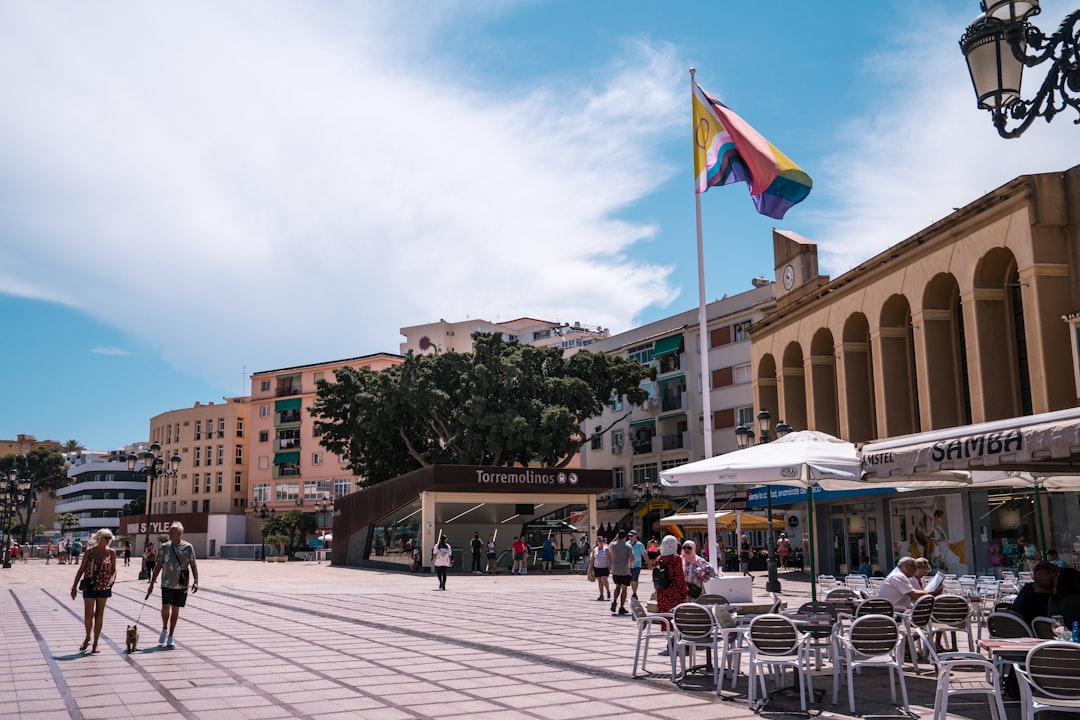
Torremolinos has a reputation — and it’s both completely deserved and wildly out of date.
Yes, it was the 1970s package-holiday capital of Europe, the place where a generation of British holidaymakers discovered sangria, paella and sunburn. But the Torremolinos of 2026 is something rather different. It is a genuine year-round town of 70,000 people. It has a cercanías train station that puts Málaga Airport eight minutes away and the city centre in under twenty. It has 8 kilometres of Blue Flag beach, a redesigned promenade, a gay-friendly Old Town that fills with locals every evening, and property prices that look almost embarrassing next to Marbella or Estepona.
That combination — infrastructure, beach, city access, value — is exactly why a particular type of British buyer keeps coming back here. Not the party crowd (they barely notice the town any more). The buyers who want a sunny base they can actually afford to own and use, with a flight path home that doesn’t require a hire car or a transfer bus.
This guide covers everything you need to make an informed decision. Prices by neighbourhood, what the schools situation actually looks like, rental yields, the buying process, legal obligations for British non-residents, and the honest downsides you won’t read on an estate agency website.
What Kind of Place Is Torremolinos?
Torremolinos sits 14 kilometres west of Málaga city on the Costa del Sol. It is technically an independent municipality (it separated from Málaga in 1988), though it sits so close to the airport that the approach path runs directly overhead — something to bear in mind if you are buying near the coast at the eastern end of town.
The resident population is around 70,000. Nationalities are genuinely mixed: British, German, Dutch, Swedish and a large domestic Spanish population, particularly in the inland neighbourhoods away from the coast. The result is that it functions as a real town, not a resort that closes down in November. Supermarkets, banks, pharmacies, GPs, schools, sports facilities — all the infrastructure of daily life is here.
The town has five distinct neighbourhoods, each with its own feel and price range. Understanding them is the single most important thing you can do before booking a viewing trip.
The Five Neighbourhoods Explained
La Carihuela
La Carihuela is the former fishing village at the western end of Torremolinos, and it is consistently the most desirable area for buyers who want character alongside the beach. The original whitewashed village streets survive behind the seafront, and the paseo marítimo here is a proper neighbourhood promenade rather than a tourist strip. The restaurants along the beachfront serve some of the best fresh fish on the Costa del Sol.
Property here is predominantly apartments, many in older blocks from the 1970s and 1980s that have been substantially updated. Expect to pay €2,800-€5,000 per square metre for frontline or first-line positions; standard apartments set back from the sea range from €2,200-€3,400/m². A well-presented 2-bedroom apartment with sea views currently sits at €280,000-€380,000 in most of the stock we see come to market.
Right for: buyers who want the coastal village feel, walkable to beach and restaurants, willing to pay a small premium within Torremolinos’s already affordable range.
El Bajondillo
El Bajondillo occupies the central coastal strip and is the most hotel-dense part of town. It has been significantly regenerated since 2018 — the promenade has been relaid, new cafés and restaurants have opened, and the beach itself was widened as part of a coastal protection programme.
This is the neighbourhood where short-let yields tend to be highest because the beach access is direct and the tourist infrastructure is all within a few minutes’ walk. The downside is noise and footfall in July and August; buyers who want a peaceful summer would be better placed in La Carihuela or Montemar.
Property prices: €2,500-€3,800/m². A 2-bedroom apartment with views runs €220,000-€320,000.
Right for: investment buyers prioritising rental yield; lifestyle buyers who want urban beach buzz.
El Calvario (Old Town Centre)
El Calvario is the pedestrianised town centre, the part most locals actually live in and most tourists wander through in the evenings. The Calle San Miguel, a traffic-free shopping street, runs through its heart. This is where you find the Mercadona, the Spanish bars, the weekly market, the pharmacies. It is decidedly less resort and more ordinary Spanish town.
Property here tends to be the most affordable in Torremolinos. Many buildings are older and smaller, and you are not paying a sea-view premium. Prices typically run €2,000-€2,800/m², meaning a reasonable 2-bedroom apartment can be found for €150,000-€220,000.
Right for: buyers on tighter budgets; those who want to live as part of a Spanish community; those prioritising year-round liveability over summer lettings.
Playamar and Los Alamos
Playamar and Los Alamos make up the eastern section of Torremolinos, running towards the Malaga airport boundary. The beach here is long and wide, and the promenade connects all the way to La Carihuela in the west. The area is less densely developed than the centre, with a mix of apartment blocks and older villas.
The flight path is a consideration for properties east of Los Alamos — there is real noise during peak arrival windows (typically 07:00-10:00 and 20:00-23:00 in summer). That said, many buyers barely notice it after a week, and it does reflect in prices.
Property: €2,200-€3,200/m². A sea-view 2-bed apartment in a decent block runs €190,000-€290,000.
Montemar
Montemar sits on the hillside above the town and represents Torremolinos’s more residential, less touristic face. It has a mixture of older villas, detached houses and small urbanisations. Gardens are common. The views west towards the sea and east towards Malaga are genuinely good, and the area is quiet in a way the seafront is not.
There is no beachfront here — you are a 15-minute walk or a short drive to the coast — but buyers who are after a proper Spanish house rather than a holiday apartment often end up here. Detached villas: €400,000-€900,000. Townhouses: €250,000-€450,000.
Right for: buyers wanting a house rather than an apartment; families; buyers who want Torremolinos’s price base without the seafront noise and crowds.
Property Prices: The Numbers in Full
The headline Torremolinos average (Tinsa Q1 2026, all property types): €2,800-€3,200/m². That compares with Fuengirola at €3,200-€4,200/m², Benalmadena at €2,600-€3,800/m², Estepona at €3,900-€4,260/m², and Marbella at €4,900-€5,400/m².
| Neighbourhood | Budget range (2-bed apt) | What you get |
|---|---|---|
| La Carihuela | €260k-€380k | Sea views, walkable to beach, character streets |
| El Bajondillo | €220k-€320k | Direct beach access, strong short-let demand |
| El Calvario | €150k-€220k | Town centre, everyday amenities, local feel |
| Playamar / Los Alamos | €190k-€290k | Wide beach, long promenade, more space |
| Montemar | €180k-€320k (apt/townhouse) | Quieter, garden, views, short drive to beach |
Prices rose approximately 6-9% year-on-year in 2025 (Colegio de Registradores data). The growth rate is slower than Estepona or Marbella, which makes Torremolinos interesting for certain buyers: it is catching up, not already repriced.
Why British Buyers Choose Torremolinos
The airport access is the most-cited reason in every conversation I have with buyers here. Eight minutes on the cercanias C1 train — a train that runs every 20 minutes for around €2.60 — puts you in the terminal. For buyers who will be commuting between the UK and their Spanish home, that is a material difference from Marbella (45 minutes by car) or Sotogrande (75 minutes).
The second reason is the price point. Torremolinos lets buyers who are priced out of Marbella or Estepona get onto the Costa del Sol at a level they can actually manage. The third: it genuinely works year-round. The Spanish population keeps the town alive in winter. The local market, the bars in El Calvario, the Thursday evening paseo — none of that stops in October. For buyers who plan to spend 3-6 months here rather than just August, that matters more than it might seem.
Lifestyle in Torremolinos
The 8-kilometre promenade from Playamar to La Carihuela is the town’s spine. Walking it in the morning, from the fishing village end past the beach bars and hotel terraces, takes about an hour. It is how Torremolinos takes its pulse.
La Carihuela’s fish restaurants — Restaurante Juan, El Roqueo, La Langosta — serve some of the most honest seafood on the coast. Prices are at local levels rather than tourist rates. A generous lunch for two with house wine runs €35-€50. The Old Town (El Calvario) has a strong cafe culture and a Saturday flea market that mixes antiques, vintage clothing and produce stalls.
Torremolinos is well known as one of the most LGBTQ+-welcoming towns on the Costa del Sol — the area around the central square has bars and venues that are genuinely inclusive and busy year-round. The beach: Blue Flag, wide enough that it does not feel crowded except in the peak of August, with warm Mediterranean water from late May through October.
Transport and Connectivity
- Malaga Airport: 8 minutes on the C1 cercanias train. €2.60 single. Trains run every 20 minutes.
- Malaga city centre: 18-20 minutes on the same C1 line. The cathedral, Picasso Museum, shopping district.
- Fuengirola: 20-25 minutes west on the C1.
- By car: N-340 coast road and A-7 motorway both pass through. Marbella 40 minutes, Estepona 50 minutes.
- Local bus: Urban bus network serves all neighbourhoods.
For a British buyer flying back to the UK every 6-8 weeks, the train-to-airport time is a practical quality-of-life point that compounds over years of ownership. No taxi, no hire car, no 45-minute transfer: walk to the station, take the train, done.
Schools in Torremolinos
Torremolinos does not have an international school with a British or IB curriculum within the town itself. The nearest options are: Aloha College (British A-levels, Nueva Andalucia, 35 minutes), The English International College (British curriculum, Marbella, 40 minutes), and International School on the Sea (ISE, Calahonda, 25 minutes).
For families with school-age children who need a British curriculum school, the daily drive is feasible but needs factoring in. There are good state primary schools in Torremolinos itself, and several concertado (semi-private) schools with bilingual programmes. Spanish state schools are free; concertado schools charge €100-€400/month.
For a family where international school is non-negotiable, Mijas Costa or the Marbella corridor would be a more practical base. For families where state or concertado education works, Torremolinos is fine.
Healthcare
Torremolinos has good private healthcare provision. The main private facility is Hospital Quiron Salud Torremolinos. Public healthcare is served through the Costa del Sol Hospital in Marbella and the Hospital Regional Universitario in Malaga city (18 minutes by train).
For British non-residents: GHIC cards cover emergency treatment. Private health insurance is strongly recommended for stays of more than a month — costs for a healthy 50-year-old run approximately €70-€120/month with Sanitas or Adeslas. Our healthcare guide for British buyers has the full breakdown.
Golf and Leisure
Torremolinos itself does not have a golf course, but the Costa del Sol’s courses are accessible: Torrequebrada Golf (Benalmadena, 10 minutes), Lauro Golf (Alhauri, 25 minutes inland), Mijas Golf (Los Olivos/Las Lagunas, 25 minutes), and Marbella’s full cluster of courses 35-45 minutes away. Other leisure includes municipal swimming pools, tennis and padel courts, cycling paths along the promenade, and seasonal water sports on the beach.
Beaches
- Playa de La Carihuela: The most atmospheric, with chiringuitos serving fresh fish all day.
- Playa de Los Alamos: Wide, less crowded, family-oriented eastern beach.
- Playa de Bajondillo: Central, busiest in summer, well-serviced and great for people watching.
- Playa de Playamar: Long, sandy, a good mix of tourists and locals.
All four carry Blue Flag status. Torremolinos has maintained Blue Flag certification consistently since 1997. The water quality is excellent.
Restaurants, Bars and Nightlife
The La Carihuela seafront has restaurants that are genuinely good rather than tourist-trap. Espetos (grilled sardines on olive wood skewers), fresh squid, grilled dorada, coquinas (small clams) — order anything from the sea and you will not be disappointed. Budget €20-€30 per head for a full meal with wine. The town centre has a good mix of Spanish bars, tapas joints and international restaurants. Several British-run pubs operate in the El Bajondillo area.
For buyers who want the sophistication of Puerto Banus — the white yachts, the designer boutiques, the €18 cocktails — Torremolinos is not that. For buyers who want honest food, local atmosphere and genuine value, it is exactly right.
Off-Plan vs Resale in Torremolinos
The off-plan new-build supply in Torremolinos is limited compared with Estepona or the Marbella New Golden Mile. The town is largely built out, and the best coastal positions are already developed. When new developments come to market — typically in Montemar or on infill sites — they tend to sell quickly.
Resale is the primary market. That is not a disadvantage. Resale properties are typically larger than new builds of comparable price, completion is immediate (no 18-36 month off-plan wait), and you can generate rental income from day one. The resale market offers genuine negotiation room — particularly in the 6-10% below-asking range for properties listed more than six months.
For a detailed breakdown of the new-build vs resale decision, see our new-build vs resale guide.
Legal and Tax Notes for British Buyers
- NIE number: You cannot complete a purchase without one. Apply at a Spanish consulate in the UK (allow 4-6 weeks) or through a Spanish lawyer once in the country. Full process in our NIE guide.
- Transfer tax (ITP): 7% of the purchase price on resale properties in Andalusia. On a €280,000 apartment, that is €19,600.
- Purchase costs: Budget 10-12% on top of the purchase price (ITP, notary, Land Registry, legal fees, gestor). On a €280,000 apartment, approximately €28,000-€33,600 in additional costs.
- Form 210 (non-resident tax): If you use the property as a holiday home, you still owe annual imputed income tax — typically €100-€400/year. Our Form 210 guide explains this in full.
- 90/180-day rule: Post-Brexit, British citizens without Spanish residency are limited to 90 days in any 180-day period in Schengen. See our Non-Lucrative Visa guide for residency options.
Rental Investment Potential
Torremolinos has a strong short-let market, particularly in La Carihuela and El Bajondillo, driven by beach access, airport proximity and strong destination recognition.
Tourist licence (VFT): Required for all short-term lets in Andalusia. Check that the property’s community statutes permit tourist letting and that the area is accepting new licence applications before you buy.
Gross rental yields (BestYieldFinder/Rentals United data, June 2026): La Carihuela 2-bed apartment: 5.2-6.8% gross. El Bajondillo 2-bed apartment: 5.5-7.5% gross. Montemar townhouse: 3.5-4.5% gross.
Net yield estimate: Deduct 15-25% for management fees, 10-12% for maintenance and running costs, and 24% IRNR tax on gross rental income (British non-residents pay on gross income, no expense deductions, post-Brexit). Real net returns tend to be 3-4.5% for a well-let property. A properly managed apartment can run 60-70% occupancy over a full year, boosted by the city-break and long-weekend market from Malaga.
For the complete rental tax picture, see our renting out your Spanish property guide.
Working With a Property Agent in Torremolinos
The Costa del Sol agency market has a fundamental problem: most agents represent the seller, not you. They earn their commission (3-6% + IVA) from the vendor, which means their interest is in completing the sale rather than in giving you the honest picture.
At My Spanish Property Finder, we take your brief, filter it against the market, and introduce you to the most relevant agents and listings — without taking a fee from any of them. That means our incentive is your satisfaction, not the fastest close. Tell us what you’re looking for.
If you are working independently: always instruct an independent Spanish lawyer (abogado) before signing anything. Expect to pay €1,500-€3,000 for full conveyancing. Our Spanish property lawyer guide covers how to find and brief one.
The Honest Downsides
- Summer noise: July and August in La Carihuela and El Bajondillo are loud. Montemar and the residential streets behind the promenade are significantly quieter.
- Flight path noise: The eastern end of town (Los Alamos, Playamar) sits under the approach path to Malaga Airport’s runway. Peak noise is early morning and late evening. Check during viewings.
- No international school in town: Families needing a British curriculum school face a 25-40 minute daily drive each way.
- Limited new-build supply: If you specifically want an off-plan new build with the latest spec, Torremolinos does not have the supply of Estepona or the New Golden Mile.
- The reputation factor: Some buyers still have a 1970s mental image of Torremolinos. The town has moved on, but perceptions are slow to follow — which works in your favour as a buyer, since prices have not fully caught up with the reality.
FAQs: Torremolinos Property for British Buyers
Is Torremolinos still a budget destination, or have prices risen significantly?
Torremolinos remains significantly more affordable than Marbella or Estepona. Average prices of €2,800-€3,200/m² compare with €4,900-€5,400/m² in Marbella — roughly a 40-45% discount. Year-on-year growth in 2025 was 6-9% (Colegio de Registradores), so prices are rising but from a much lower base. Buyers who acted in 2022-2023 have seen good capital growth.
Can I get a tourist licence for a short-let apartment in Torremolinos?
Tourist licences (VFT) are available in Torremolinos, but the Junta de Andalucia has tightened the process across Malaga province. Some apartment buildings have community rules restricting tourist lets. Always check that the community statutes permit tourist letting and that the local authority area is accepting new VFT applications. A local lawyer can do both checks before you commit.
How does the Malaga Airport train connection work in practice?
The C1 cercanias line has a stop at Torremolinos (Avenida de los Manantiales) and one at the airport terminal. Trains run approximately every 20 minutes from around 06:30 to 23:00. The journey takes 8 minutes. A single ticket costs €2.60. No advance booking required — buy at the machine or use a transport card.
What is the 90-day rule and does it affect British buyers in Torremolinos?
Post-Brexit, British citizens who are not resident in a Schengen country are limited to 90 days in any rolling 180-day period within Schengen (which includes Spain). A British holiday-home owner can spend up to approximately 6 months per year in Spain, not consecutively. To spend more time, you need a Non-Lucrative Visa (income-based) or Digital Nomad Visa.
Are community fees high in Torremolinos?
It depends on the building and its facilities. A basic apartment block with no pool or gym: €60-€120/month. A building with communal pool, gardens and a porter: €150-€300/month. A front-line complex with extensive facilities: €300-€500/month. Always request the community fee certificate and the last three sets of meeting minutes before you buy.
What taxes do British non-residents pay on a property in Torremolinos?
The main ongoing obligations: IBI (council tax equivalent, €200-€800/year depending on cadastral value); Form 210 imputed income tax on a holiday home (approximately €100-€400/year); and, if you rent the property out, 24% IRNR on gross rental income with no expense deductions for UK non-residents post-Brexit.
Is Torremolinos good for a permanent move rather than just holidays?
Yes, genuinely. The year-round resident population of 70,000, cercanias access to Malaga city, full everyday services and an active local culture make it work as a permanent base. British retirees particularly value the combination of price, sun, beach and city access. See our retiring to Spain guide for the financial planning side.
The Buying Process in Brief
- Agree terms and pay a reservation fee (€3,000-€6,000) to take the property off the market while due diligence runs.
- Your lawyer conducts searches: Nota Simple, community certificate, IBI receipts, occupation licence, planning status.
- Sign Contrato de Arras Penitenciales: Private purchase contract with 10% deposit. If the seller pulls out, they owe you double. If you pull out, you lose the deposit.
- Completion at the notary (escritura de compraventa): Final payment, keys exchanged.
- Post-completion: Land Registry registration (15-60 days), utility transfers, IBI registration.
Budget 10-12% on top of purchase price for all costs (ITP 7%, notary, Land Registry, legal, gestor). For a full timeline, see our guide to how long it takes to buy property in Spain.
Next Steps: Find Your Torremolinos Property
Torremolinos suits a specific type of buyer: one who values airport access, wants a genuine year-round community, needs a price point that does not require stretching uncomfortably, and is not looking for a postcode to impress people at dinner parties.
If that sounds like you, tell us your budget, which neighbourhood appeals, and how you plan to use the property. We will shortlist the most relevant agents and listings — including properties not yet on the open market. No hard sell, no agency fees from you, and no reason to hold back the honest assessment if a property is not right for you.
Browse Torremolinos properties and tell us what you are looking for
Always verify tax rates and legal requirements with a qualified Spanish abogado and gestoria. Rates quoted are current as of mid-2026 and subject to change.