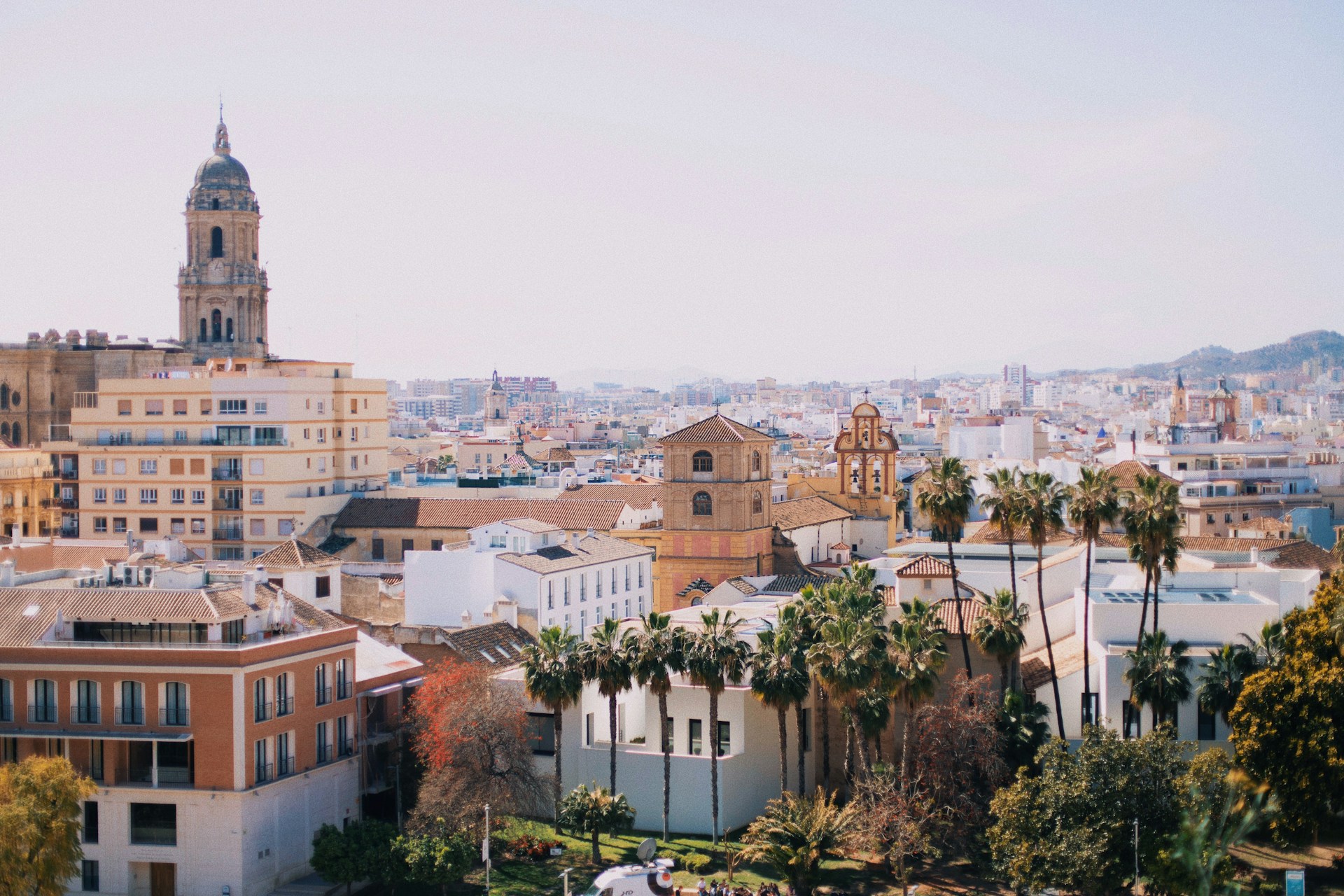
Málaga Property for Sale: The Complete Guide for British Buyers
For years, British buyers on the Costa del Sol drove straight through Málaga to reach Marbella or Estepona. That habit is fading fast.
Málaga city is having its moment. The historic centre has been transformed over the past decade: the Picasso Museum, a branch of the Pompidou Centre, the Carmen Thyssen Gallery, a genuine food scene built on local talent rather than tourist menus, and a port that was a derelict wasteland in 2000 and is now lined with restaurants and sailing berths. Property prices are still meaningfully below Marbella. Direct flights from more than 30 UK airports land eight kilometres from the city centre. The AVE high-speed rail link put Madrid two hours and 25 minutes away, and the cercanías suburban train connects Málaga to Torremolinos, Fuengirola and the whole western coast in under 40 minutes.
The buyers arriving in Málaga today are a different profile from the golf-resort crowd. They are remote workers who want a functioning European city with a fast internet connection and a proper coffee culture. They are retirees who want museums, markets and pavement cafes within walking distance. And they are investors chasing the short-let yields a year-round city destination produces. If any of those sound like you, this guide is for you.
Why Málaga Is Different from the Rest of the Costa del Sol
The Costa del Sol’s resort towns are purpose-built for holiday living: golf courses, beach clubs, communal pools, hire cars for everything. Málaga is a real Andalusian city of 580,000 people. It has a medieval Alcazaba fortress, a Roman theatre, the birthplace of Picasso, a thriving tech sector (the Málaga Tech Park employs more than 22,000 people), four universities and a resident population that actually uses the city all year round.
That distinction matters if you are buying property to live in rather than to unlock a warm-winter holiday. In Málaga you can walk to the market, the pharmacy, the cinema and the beach. In most Costa del Sol urbanisations you need a car for all four.
It also matters for rental investment. While many beach resorts have a glut of identical two-bedroom apartments competing for the same summer visitors, Málaga attracts city-break tourists, business travellers, conference delegates and long-stay digital nomads. Demand spreads across 12 months rather than concentrating in July and August.
The Málaga Property Market in 2026: Prices by Neighbourhood
Málaga is not a single market. Prices vary sharply by neighbourhood, and understanding the zones is the most important thing you can do before viewing a single property.
Centro Histórico and Soho
The historic centre runs from the cathedral north towards the Alcazaba. Soho is the creative district directly below the centre, sandwiched between the main shopping street and the port. These are the highest-demand zones, with the tightest supply and the fastest price growth.
Expect to pay between €3,500 and €6,000 per square metre for a renovated apartment. A 75-square-metre two-bedroom flat in good condition in the Centro Histórico typically lists between €280,000 and €450,000. Penthouses with terrace views over the cathedral or the port regularly exceed €600,000. Supply is genuinely limited: the historic grid cannot be densified, so every new unit that comes to market is a converted period building rather than a new tower.
La Malagueta
La Malagueta is the beach neighbourhood immediately east of the port. It is the closest Málaga gets to the traditional Costa del Sol apartment model: a beachfront promenade with medium-rise residential blocks, bars and restaurants. The beach is wide, sandy and Blue Flag-rated.
Prices here run from €3,200 to €5,500 per square metre. A 90-square-metre two-bedroom apartment with a sea view costs between €320,000 and €500,000. Frontline properties command a significant premium. Short-let demand is very strong given the beach access and the short walk into the city centre.
Pedregalejo and El Palo
These eastern beach barrios, roughly 4 to 6 kilometres from the centre, are where Malagenos actually live. The promenade is lined with chiringuitos (beach restaurants) that are genuinely good rather than tourist traps. The housing stock is a mix of older apartments and some recent new-build developments further back from the sea.
Prices are lower than the centre: €2,500 to €3,800 per square metre. A two-bedroom apartment in Pedregalejo costs roughly €200,000 to €320,000. The trade-off is a bus or EMT metro ride into the city rather than a ten-minute walk. For buyers prioritising beach lifestyle over city walkability, Pedregalejo is the strongest value proposition in Málaga.
Teatinos and Campus de Teatinos
Teatinos is the university district in the western part of the city, home to the University of Málaga campus and a large number of modern apartment blocks. It is the most affordable residential area within the city boundary.
Prices range from €1,800 to €2,800 per square metre. A two-bedroom apartment can be found for €150,000 to €220,000. This is primarily a long-let investment area rather than a lifestyle purchase: the rental market is driven by students and young professionals rather than tourists.
Churriana and Málaga Oeste
West of the city, towards Málaga Airport, lies a band of residential suburbs including Churriana, El Cónsul and parts of Campanillas. These are mainly detached villas and low-density housing popular with families who work in the city but want space and a garden.
Villa prices in this zone start around €350,000 for a three-bedroom detached house and rise to €800,000 for larger properties with pools. The airport is five minutes by car, which suits frequent flyers but means aircraft noise is a factor worth assessing on any specific plot.
Property Types Available in Málaga
Renovated period apartments in the historic centre are the prestige purchase. These are typically in buildings from the 19th or early 20th century, with high ceilings, tiled floors and sometimes a small interior courtyard. Renovation quality varies: always check whether works have building permission and whether the community has pending derramas (special assessments).
Modern apartments dominate La Malagueta, Pedregalejo and Teatinos. These are lower-maintenance, more energy-efficient and easier to short-let without the complications of a historic building.
Penthouses with private terraces are available across all neighbourhoods and command premiums of 20 to 35% over equivalent lower-floor units. In a city with 300 days of sunshine per year, a private terrace is not a luxury: it is effectively an extra room for eight months of the year.
Villas and townhouses exist mainly in the western suburbs and in urbanisations that technically fall within the Málaga municipality but feel more like satellite villages (Churriana, Alhaurín de la Torre, Torremolinos is within the municipality boundary).
Off-plan is limited in the city core but growing in the outer districts and in Málaga Este (eastern suburbs). Several developers are building new apartment blocks in El Limonar, Ciudad Jardín and the eastern coastal strip towards La Cala del Moral.
Why British Buyers Choose Málaga
The airport situation is unmatched. Málaga-Costa del Sol Airport (AGP) is the fourth-busiest airport in Spain, with direct routes from London Heathrow, Gatwick, Stansted, Luton, City, Manchester, Birmingham, Bristol, Edinburgh, Glasgow, Liverpool, Leeds Bradford and more than 20 other UK airports. The city centre is reachable by the X1 bus in 15 minutes (€3) or by taxi in ten minutes (€20 to €25). Nowhere else on the Costa del Sol has this level of UK connectivity.
Year-round city life with no car required. The historic centre, La Malagueta and Soho are fully walkable. The EMT bus network and the new metro line serve the wider city. For the Costa del Sol coast, the cercanías train from Málaga Centro-Alameda station reaches Torremolinos in 20 minutes, Benalmádena in 25 minutes and Fuengirola in 37 minutes. You can live in the city without a car and still have beach access.
Culture and intellectual life. Málaga has more museums per square kilometre than almost any city in Spain. The Picasso Museum (in the house where he was born) receives more than 600,000 visitors a year. The Pompidou Málaga is the only Pompidou Centre branch outside France. The Carmen Thyssen Málaga has a permanent collection of Andalusian 19th-century painting plus rotating international exhibitions. The Contemporary Art Centre (CAC) is free. For buyers who found Marbella a bit glossy and light on intellectual stimulation, Málaga hits differently.
The food scene. Málaga has developed a serious restaurant culture in the past decade. El Refectorium in the Soho district has two Michelin-recommended restaurants on the same block. Kaleja (Dani Carnero’s tasting-menu restaurant) holds a Michelin star. The Mercado de Atarazanas is one of the best food markets in Andalusia. For everyday eating, the Centro and Pedregalejo chiringuito culture means excellent fresh fish and seafood at prices that would be laughable in London.
The remote-working infrastructure. The Málaga Tech Park (PTA) has attracted companies including Google, Oracle, Vodafone and Fujitsu. Co-working spaces are abundant. Fibre-optic broadband coverage in the city is above 95%. For British buyers working remotely for UK employers under the Digital Nomad Visa, Málaga is the most popular single destination in Spain.
Transport and Connectivity
Málaga Airport (AGP): 8km from the city centre. City bus X1 every 20 minutes, €3. Taxi €20 to €25. Metro Line 1 from the airport to the city centre is under construction and expected to open in 2027.
Cercanías suburban train: The C1 line runs from Málaga Centro-Alameda west to Fuengirola, stopping at Málaga María Zambrano mainline station, Málaga Victoria (for the hospital), Torremolinos, Benalmádena-Arroyo, Torreblanca and Fuengirola. Frequency: every 20 minutes off-peak, every 12 minutes at peak. Price: €2.05 to €2.60 depending on zone. This makes Málaga a practical base for buyers who want city living during the week and beach access at weekends.
AVE high-speed rail: The Málaga María Zambrano station connects to the national AVE network. Madrid is 2 hours 25 minutes away. Córdoba is 1 hour. Seville is 2 hours 5 minutes. Granada is 55 minutes via the new Antequera-Santa Ana junction (opened 2020).
Driving: The A-7/AP-7 coastal motorway runs west from Málaga to Estepona (55 minutes) and east towards Almería. The A-45 north connects to the A-92 for Granada and the M-30 ring road. Parking in the city centre is difficult and expensive; most historic-centre apartments do not include a parking space (budget €80 to €120 per month for a private garage).
Schools in Málaga
British buyers with children face an honest trade-off in Málaga city. There is no British curriculum school within the city boundary itself. The nearest British-curriculum options are:
- The English International College (EIC): Mijas Costa, 30 kilometres west. National Curriculum for England, Years 1 to 13, fees €7,200 to €13,500 per year. Widely used by families based in the western Costa del Sol.
- Aloha College: Nueva Andalucía, 45 kilometres west. British curriculum, strong A-level record.
- Swans International School: Marbella, 50 kilometres west. British curriculum from age 3.
Within Málaga city, the international school landscape is:
- Colegio Alemán de Málaga: German curriculum, strong academic reputation, accessible to non-German speakers for the early years.
- Liceo Europeo and several bilingual Spanish concertados: Spanish national curriculum with heavy English immersion. A good option if your children are young enough to acquire Spanish naturally.
For buyers with primary-school-age children, the commute to British curriculum schools from Málaga city is workable but long. Families with secondary-school children who want GCSEs and A-levels typically find the western costa towns (Mijas Costa, Fuengirola) a more practical base. For buyers without children, or with pre-school children, Málaga has no meaningful disadvantage here.
Healthcare in Málaga
Málaga city has the best public hospital infrastructure on the Costa del Sol. The Hospital Regional Universitario de Málaga and the Hospital Universitario Virgen de la Victoria are large public tertiary hospitals with specialist departments unavailable at smaller coastal facilities. If you require anything beyond routine primary care, you will eventually be referred to one of these.
For private healthcare, the options are:
- Quirón Málaga: Part of the Quirón Salud group (Spain’s largest private hospital operator). English-speaking specialists in most departments. Widely used by expatriates.
- Vithas Málaga (formerly Parque Clínico): Comprehensive private hospital in the Teatinos district. Strong cardiology and orthopaedics departments.
- HM Hospitales Málaga: More recently opened, convenient for patients in the city centre and Soho.
For the standard British buyer question about GHIC cards, S1 forms and private health insurance requirements under the Non-Lucrative Visa, see our dedicated Costa del Sol healthcare guide for British residents. The short version: if you are a resident, you need private health insurance for the first year until you can access the public system via empadronamiento and Tarjeta Sanitaria Individual (TSI).
Golf and Leisure
Málaga city itself is not a golf destination. The nearest courses are:
- Real Club de Golf de Málaga (Parador): 8km east of the city, within the city municipality. A historic club (founded 1925) on the Guadalhorce river delta. Green fees from €70 to €90.
- Club de Golf Añoreta: 20km east in Rincón de la Victoria. 18-hole championship course, €55 to €80 green fee.
- Club de Golf El Candado: 7km east, a 9-hole course used mainly by club members.
For serious golfers, the western Costa del Sol (Marbella, Estepona, Mijas) is unquestionably better served, with 60+ courses within a 60-minute drive of the city. If golf is your primary leisure driver, Málaga city is better suited as a hub than a destination.
What Málaga does offer by way of leisure: sailing from the Real Club Náutico (membership-based, but berths available), cycling along the Málaga-Fuengirola coastal greenway, hiking in the Montes de Málaga Natural Park (15 minutes from the city centre), and a city beach (La Malagueta) that is perfectly usable from April to October.
Beaches
La Malagueta is the city’s main urban beach: 1.2 kilometres of grey-golden sand, four Blue Flags, well-maintained with showers, lounger rental and lifeguards. It is crowded in July and August but perfectly pleasant in May, June, September and October. The promenade runs directly to the port and the Paseo del Parque botanical gardens.
Pedregalejo and El Palo (4-6km east) offer a string of smaller, quieter coves. The chiringuito culture here is some of the best on the coast: espetos de sardinas (grilled sardines on cane skewers over open fires) on the beach, ice-cold Cruzcampo, watching the boats. Restaurants to try: El Tintero (legendary Sunday lunch, chaotic, loud, brilliant), La Reserva 12 (more refined), El Calamar (reliable fresh catch every day).
Rincon de la Victoria and La Cala del Moral (20 minutes east by car or cercanías) offer wider, less crowded beaches if you want to escape the city entirely.
Restaurants and Nightlife
Málaga’s food scene deserves its own guide, but these are the names worth knowing as a buyer:
Fine dining: Kaleja (Michelin star, Dani Carnero, tasting menu from €85), Tribeca (creative Andalusian, Soho), El Percebe (inventive seafood, La Malagueta).
Everyday quality: Bar Lo Güeno (classic Malageno bar, excellent anchovies), Casa Lola (updated tapas, busy at lunch), Los Mellizos (traditional, reliable), El Cabra (old-school, local crowd, extraordinary value).
Breakfast and coffee: Cafeína (Soho, best coffee in the city), La Recova Gastrotaverna (weekend brunch), Café Central (Plaza de la Constitución, historic, worth a visit once for the setting).
Markets: Mercado de Atarazanas (fruit, veg, fish, jamón, olives, closing at 3pm). Mercado del Carmen (smaller, Soho, good prepared food stalls).
Nightlife in Málaga is concentrated in the Soho, La Malagueta and the Centro. The city has a younger, more local demographic than Puerto Banús. Bars here are open late rather than clubs. The terrace on top of the AC Hotel Málaga Palacio for a sundowner with Alcazaba views is one of the genuinely great free (or nearly free) experiences on the coast.
Rental Investment Potential in Málaga
Málaga’s short-let rental market is one of the strongest in Andalusia for investors. Key figures:
Short-let (Airbnb/VRBO) yields: 5.5% to 8% gross for well-located city apartments. The Centro Histórico and La Malagueta outperform because of year-round demand from city-break tourists, conference visitors (the Palacio de Ferias y Congresos generates significant midweek hotel demand) and business travellers visiting the Tech Park.
Long-let yields: 4% to 5.5% gross. Long-let rents in Málaga have risen sharply since 2022, driven by tech sector employment growth and limited housing supply in the urban core. A 75-square-metre two-bedroom flat in the Centro can command €1,200 to €1,600 per month on a long-let basis. The Teatinos university area yields are lower (€650 to €900/month) but with lower acquisition prices.
Important licensing point: Andalusia requires a Vivienda con Fines Turísticos (VFT) licence for any short-let property. Applications go through the Junta de Andalucía’s DUCA portal. In Málaga city, the Ayuntamiento has been tightening short-let rules in certain zones (particularly the historic centre), and there have been discussions about restricting new VFT licences in saturated areas. Before buying for short-let purposes, verify the current licensing position in your specific street or building. Our guide to renting out your Spanish property covers the full process including tax obligations.
Tax note for UK owners: As a British non-resident landlord, you pay 24% tax on gross rental income with no expense deductions. This is a material difference from EU owners, who pay 19% on net income. Factor it into your yield calculations from the start. See our Form 210 guide for the filing mechanics.
Off-Plan vs Resale in Málaga City
The Málaga city market is overwhelmingly a resale market in the historic districts. New development in the Centro Histórico is rare and expensive; the urban fabric is protected and plot availability is minimal. When new units do appear, they are typically conversions of existing buildings rather than ground-up construction.
Off-plan opportunities exist in:
- Málaga Este (El Limonar, Ciudad Jardín, La Cala del Moral border)
- The western suburbs (Churriana, Campanillas) where new villa developments are active
- Rincón de la Victoria (technically a separate municipality but within 20 minutes east)
The usual off-plan caveats apply: verify the developer’s bank guarantee (aval bancario) under Ley 57/1968, insist on a stage-payment schedule tied to construction milestones, and commission an independent architect to sign off each phase before releasing funds. See our new-build guide for the full checklist.
For most British buyers targeting Málaga city, resale is the more practical route. Supply is genuinely constrained, and a motivated seller willing to negotiate is often a better deal than an off-plan unit at optimistic developer pricing.
The Legal and Tax Picture for British Buyers
Nothing in the Málaga city purchase process is fundamentally different from buying elsewhere on the Costa del Sol. The key numbers:
- Transfer tax (ITP): 7% of the purchase price for resale properties in Andalusia
- IVA + AJD for new-builds: 10% IVA plus 1.2% AJD (Actos Jurídicos Documentados) = 11.2% total
- Notary fees: typically €600 to €1,500 depending on the price
- Land Registry: €300 to €800
- Legal fees (abogado): 1% to 1.5% of purchase price plus IVA, plus €500 to €1,000 for due diligence searches
On a €380,000 apartment, total purchase costs typically land between €32,000 and €42,000 above the purchase price. Our full cost breakdown guide has a worked example.
NIE number: You cannot complete a property purchase in Spain without a Número de Identificación de Extranjero. Applications can be made from the UK before you travel. See our NIE guide for the step-by-step process.
Form 210: If you own property in Spain but are not a tax resident, you must file an annual Form 210 tax return (imputed income tax on your property). This applies whether or not you rent it out. See our Form 210 guide.
Always use an independent Spanish property lawyer (abogado) who acts for you, not the developer or the seller. The due diligence on a Málaga city apartment is particularly important: check the Nota Simple for debts or liens, confirm the community fees and any outstanding derramas, verify the cédula de habitabilidad (occupation licence) and confirm any renovation works were done with proper planning permission (licencia de obras).
Working with a Property Agent in Málaga
The Málaga market has a different dynamic from the Costa del Sol resort market. The major international agencies (Engel & Völkers, Knight Frank, Savills, Lucas Fox) all have Málaga city offices now. There are also strong local Spanish agencies (Monapart Málaga, Inmobiliaria Navas & Cusí) with deep knowledge of the historic centre.
The single-agent trap that plagues resort property buyers (one agent shows you only their listings and you never see the rest of the market) is acute in Málaga because the city market is fragmented across dozens of agencies with limited overlap. Using a buyer’s agent or an agent with a wide mandate to search across the MLS gives you a materially better view of available stock.
At My Spanish Property Finder, we work with you to identify which neighbourhood and price point match your goals, and then reach into our network to surface properties that match, including off-market stock that never appears on Rightmove Spain or Idealista. Get in touch and tell us what you are looking for.
Málaga vs Other Costa del Sol Locations: How It Compares
| Factor | Málaga City | Marbella | Torremolinos | Benalmádena |
|---|---|---|---|---|
| Price per m² (avg) | €3,000-5,000 (centre) | €4,900-5,400 | €2,800-3,200 | €2,200-3,000 |
| Airport distance | 8km (10-15 min) | 60km (45-55 min) | 12km (C1 train 8 min) | 20km (C1 train 12 min) |
| Car needed? | No (city centre) | Yes | No (C1 train) | Partially |
| Short-let yield | 5.5-8% gross | 3.5-5.5% gross | 5.2-7.5% gross | 4.5-6% gross |
| Cultural offer | Excellent | Limited | Basic | Basic |
| British schools nearby | No (30-50 min drive) | Yes (20-30 min) | No (15-20 min) | No (25 min) |
| Golf access | Limited (20+ min) | Excellent (10 min) | Moderate (30 min) | Moderate (30 min) |
Málaga wins on city life, cultural offer, airport access and year-round rental demand. It loses on golf, British school proximity and the beach lifestyle that most traditional Costa del Sol buyers are seeking. Know what you want before you decide.
Frequently Asked Questions
Is Málaga a good place to buy property as a British buyer in 2026?
Yes, for the right buyer profile. Málaga city offers strong rental yields, excellent UK flight connections, year-round demand and a genuinely improving urban environment. It is best suited to remote workers, city-lifestyle buyers, culture-seekers and investors targeting year-round short-let income rather than buyers whose primary goal is beach-resort living.
What are property prices in Málaga city right now?
In the historic centre and Soho, prices run from €3,500 to €6,000 per square metre. La Malagueta (beachfront) is €3,200 to €5,500 per square metre. Pedregalejo and El Palo are €2,500 to €3,800 per square metre. Teatinos (university area) is the most affordable at €1,800 to €2,800 per square metre.
Can I get a short-let licence (VFT) for a Málaga city apartment?
Yes, but check carefully before you buy. The Junta de Andalucía issues VFT licences for the Andalusia region, but Málaga’s Ayuntamiento has been discussing restrictions in saturated historic-centre zones. Verify the current position in the specific street or building, and check whether the community of owners has voted to prohibit tourist rentals (some buildings have done so under changes to the Ley de Propiedad Horizontal).
How do I get from the UK to Málaga?
More than 30 UK airports fly directly to Málaga-Costa del Sol Airport (AGP). Flights from London Gatwick take about 2 hours 30 minutes. From Manchester, roughly 2 hours 45 minutes. From Edinburgh, about 3 hours. Málaga is one of the best-connected Spanish airports for UK passengers outside Madrid and Barcelona.
Are there British schools in Málaga city?
There is no British curriculum school within the city boundary. The nearest are The English International College in Mijas Costa (30km west) and Aloha College in Nueva Andalucía (45km west). Families with school-age children should factor in the commute or consider whether a bilingual Spanish school is a workable alternative for primary-age children.
What is the buying process timeline for a Málaga property?
For a cash buyer, the process from offer accepted to keys typically takes 8 to 14 weeks: around 1 to 2 weeks for due diligence and NIE, then 2 to 4 weeks to arras (private purchase contract with 10% deposit), then 6 to 8 weeks to completion at the notary. Mortgage buyers typically add 4 to 8 weeks for the Spanish mortgage process. Our buying timeline guide has the full breakdown.
Do I need a Spanish bank account to buy in Málaga?
Yes. The purchase funds must arrive in Spain via a Spanish bank account (IBAN ES). Funds wired directly from a UK account to the notary are not accepted in the way they would be in the UK. Opening a Spanish non-resident account is straightforward and should be one of your first steps. See our Spanish bank account guide.
Next Steps: Finding Your Málaga Property
Málaga’s market moves quickly in the best-positioned neighbourhoods. Properties in the historic centre at sensible prices attract multiple offers within days of listing. Getting into the market with clear criteria and pre-arranged finance is more important here than in the slower resort markets.
Here is the practical sequence:
1. Define your budget including all costs. A €350,000 property will cost approximately €375,000 to €395,000 all-in.
2. Get your NIE number sorted before you travel. See our NIE guide.
3. Appoint a Spanish property lawyer (abogado) independently before signing anything.
4. Sort your currency strategy. GBP/EUR moves by 5% in either direction during a typical purchase process. A forward contract with a specialist broker (Currencies Direct, Moneycorp, OFX) can lock in your exchange rate today. Our currency hedging guide explains how.
5. Talk to us. We can recommend properties across Málaga’s neighbourhoods that match your goals, including stock that does not appear on the major portals.
Ready to explore Málaga? Tell us what you are looking for and we will send you a shortlist.