Fuengirola for British Families: Value, Schools and What Life Is Actually Like
Marbella and Estepona get all the headlines, but British families quietly keep choosing Fuengirola — and they have been for 30 years. The reasons are practical: a train that takes you to Málaga airport in under 30 minutes, a proper town centre that functions year-round, and apartment prices that still make sense for families on normal budgets. In Q2 2026, a two-bedroom apartment in Los Boliches costs less than a studio in Puerto Banús.
This guide covers what Fuengirola is actually like for British families with children: which neighbourhoods work, what you pay, where the schools are, and what day-to-day life looks like once the novelty wears off.
What kind of town is Fuengirola?
Fuengirola is a working coastal city of around 80,000 residents — roughly double during summer. Unlike many Costa del Sol towns that exist primarily for tourists and second-home owners, Fuengirola has a real economy: local businesses, supermarkets, a weekly market, a hospital, and a town hall that keeps the bins collected. It is less polished than Marbella and less boutique than Estepona, but it is more functional than either for year-round family living.
The British presence is large and long-established. The area around Los Boliches in particular has decades of British expat history — English-language GP services, British-owned estate agents, and restaurants serving Sunday roasts within walking distance of the beach. That community creates practical advantages: local knowledge about NIE processing, school admissions, and healthcare is easy to tap into.
Fuengirola’s neighbourhoods: where to buy
Fuengirola is not a single neighbourhood — it covers around 10km of coastline and has distinct zones with different price levels and characters. Knowing which one suits your family matters more than knowing the town-wide average.
Carvajal and Las Gaviotas (northern end)
Carvajal is Fuengirola’s premium corner, sitting at the northern border with Benalmádena. It has the best beaches, the cleanest water, and the highest prices in the municipality — averaging around €5,200–5,300 per square metre in 2026. An 80–100m² apartment here costs €420,000–530,000. The area is popular with international buyers who want Fuengirola’s practicality but are willing to pay Benalmádena-adjacent prices.
For families, Carvajal works well if the school run matters less than beach access and easy access to the AP-7. It is quieter than central Fuengirola in winter.
Los Boliches (mid-town, beachfront and inland)
Los Boliches is where most British buyers end up looking first, and with reason. It offers a genuine neighbourhood feel — local bars, a weekly market, a beach, and easy walking access to the train station. Prices split clearly by distance from the water: beachfront apartments (Playa de Los Boliches) run €4,550–4,650/m², while the streets one or two blocks inland drop to €3,700–3,900/m².
In practical terms: a two-bedroom apartment of around 75m² one street back from the beach costs €260,000–320,000. A beachfront equivalent with a sea view from the terrace runs €370,000–460,000. Both figures are substantially below what equivalent properties cost in Marbella or even Estepona’s frontline.
Torreblanca del Sol
Torreblanca occupies the stretch between Los Boliches and Carvajal. It has been developing steadily, with newer apartment blocks alongside older resale stock. Prices average €4,800–4,850/m². It suits buyers who want something between Los Boliches and Carvajal — quieter than central Los Boliches, less expensive than Carvajal.
El Castillo and the town centre
The town centre around Sohail Castle and the marina offers the most urban experience in Fuengirola. Prices here are mixed — €3,400–4,650/m² depending on the specific street and building age. It works well for families who prioritise amenities and do not need to be on the sand.
Los Pacos (inland, most affordable)
Los Pacos is Fuengirola’s most affordable residential area, sitting inland from the coastal strip. Prices average €3,200–3,450/m². An 80–100m² apartment here costs €260,000–345,000. For families where budget is the priority and beach proximity matters less than space and value, Los Pacos delivers both. It is a 10-minute drive (or a short bus ride) to the beach.
Property prices in 2026: what you actually pay
The Fuengirola municipality average in Q2 2026 is approximately €4,500–5,000/m² for coastal apartments, with growth running at around 6–7% year-on-year (Indomio, June 2026). That growth rate is lower than Estepona’s 12–15% and significantly lower than Marbella’s stronger performers, which is precisely what makes Fuengirola accessible — prices are rising steadily without the sharp compression of supply that characterises the Golden Triangle.
| Neighbourhood | Avg €/m² (2026) | 80–100m² apartment |
|---|---|---|
| Carvajal / Las Gaviotas | €5,200–5,300 | €420,000–530,000 |
| Playa de Los Boliches (beachfront) | €4,550–4,650 | €370,000–460,000 |
| Torreblanca del Sol | €4,800–4,850 | €380,000–485,000 |
| Los Boliches (inland) | €3,700–3,900 | €260,000–320,000 |
| Town centre / Marina | €3,400–4,100 | €270,000–410,000 |
| Los Pacos (inland) | €3,200–3,450 | €260,000–345,000 |
Sources: Settli (late 2025), Engel & Völkers June 2026, Indomio June 2026, realestatemijas.com (2026 listing data). Figures are asking prices; transaction prices typically 5–10% lower.
One-bedroom apartments in Los Boliches second-line (one street back from the beach) start at around €145,000–220,000. That entry point is what draws British first-time buyers and those buying for a holiday rental income stream rather than a luxury lifestyle.
Schools for British children
The first thing to understand about schooling in Fuengirola is that the town’s boundaries do not define the school zone. Fuengirola, Mijas Costa, and Benalmádena function as a single school corridor — the AP-7 and coastal road connect them in under 15 minutes, and most international schools run bus routes across all three municipalities.
St. Anthony’s College (Mijas Costa) is the anchor school for the area: British curriculum, ages 3–18, and one of the longest-established international schools on the entire Costa del Sol. Annual fees run from approximately €8,000 to €13,000 depending on year group.
Spanish concertado (semi-private) schools are an option that many British families overlook. These are bilingual, receive government subsidy, and charge minimal fees — effectively free in some cases. They require full immersion in Spanish from day one, which most children adapt to faster than their parents expect. If your children are primary-age and you plan to stay long-term, a concertado school followed by international secondary is a well-trodden path in this area.
Fees across the corridor: free (concertado) to €13,000/year (British curriculum private). Confirm school bus routes before committing to a specific property — coverage is good but not universal.
Getting around: the C1 train is genuinely useful
The Cercanías C1 line connects Fuengirola to Málaga city centre and Málaga airport on a single route, running every 20 minutes during the day. From Fuengirola station (which serves Los Boliches directly), the journey to Málaga airport (Málaga Aeropuerto station) takes around 25 minutes. To Málaga city centre: around 35 minutes. The fare is approximately €2.60 each way.
For British families flying back to the UK two or three times a year, this is a material quality-of-life advantage over towns further west. There is no equivalent direct rail link in Estepona or Marbella — those require a taxi, Uber, or the AP-7. Over 5 years of school holidays and work trips, the difference adds up.
Within the town, a car is useful but not essential the way it is in hillside communities like Benahavís or even parts of Marbella. The beach, the supermarkets, the train station, and most schools reachable by bus or short drive are all within a manageable radius.
The beach: 8km of promenade
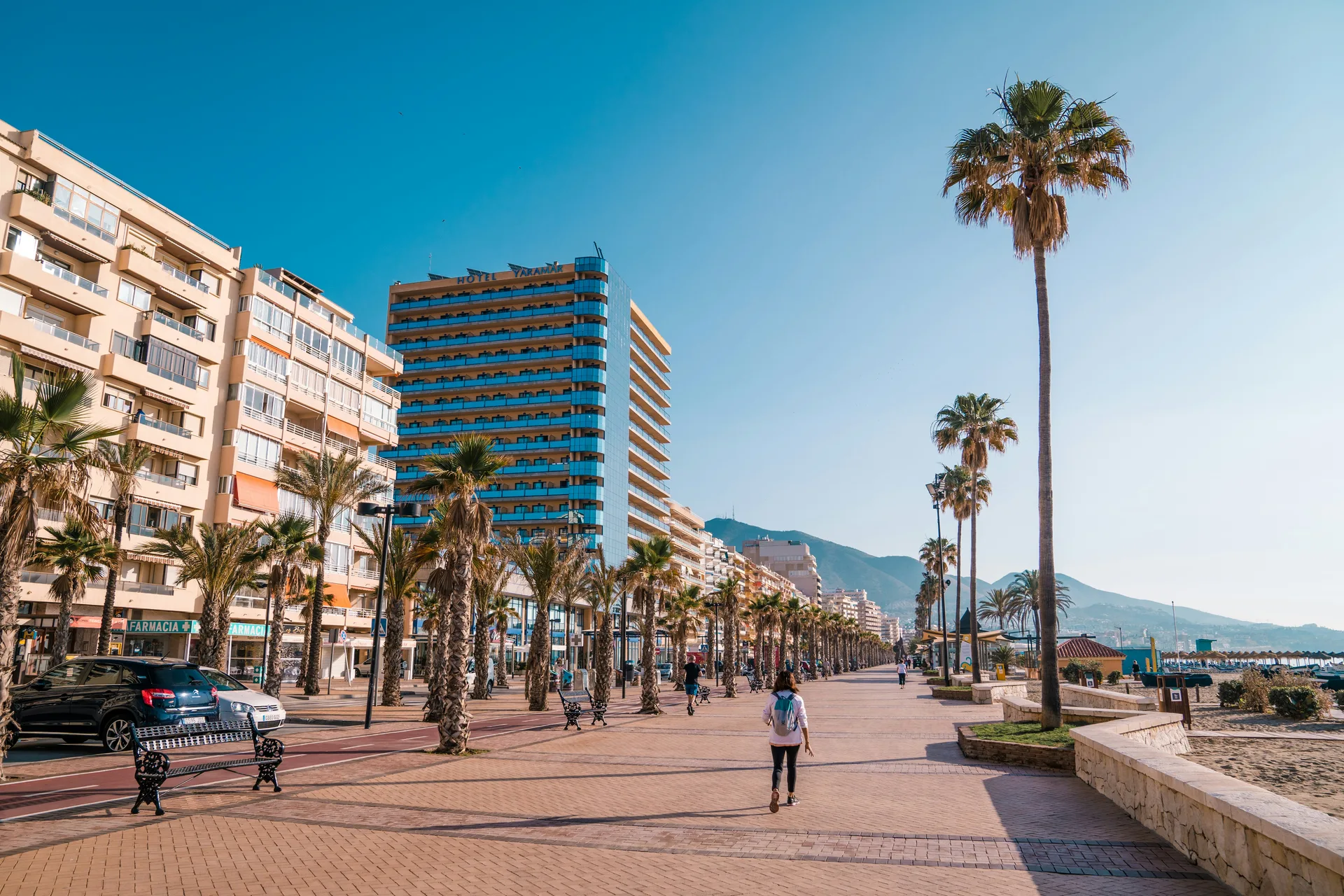
Fuengirola’s main asset is 8km of sandy beach running the full length of the town, connected by a continuous promenade. The beach is organised, clean, and has facilities — sunbeds, chiringuitos (beach bars), and lifeguard coverage during the season. It is not the quiet cala you find on the Sotogrande coast, but for families with children who want to spend every weekend within walking distance of sand and water, it does the job.
Carvajal’s stretch of beach at the northern end is generally the least crowded and has cleaner water than the central town beach. Los Boliches beach, being the most accessible for residents, is busier in summer but manageable outside July and August.
Rental potential
Fuengirola is a reliable rental market for both short-term and long-term lets. Gross short-let yields for a well-located two-bedroom apartment typically run 4.5–6%, with Los Boliches and Carvajal performing at the stronger end of that range. The town draws a mix of Spanish domestic tourists, Northern Europeans, and long-stay visitors rather than the luxury short-break market that dominates Marbella.
Long-let demand is strong year-round, driven by the established expat community and professionals working in the Málaga tech corridor. A two-bedroom apartment in Los Boliches rents for approximately €1,100–1,500/month long-term. That gives a gross yield of around 4.5–5% on a property purchased at €280,000–300,000 — before taxes, community fees, and management costs.
Tourist licence (VFT) requirements apply to short lets in Fuengirola as elsewhere in Andalusia. Factor in a 4–6 month wait for the licence and the 24% non-resident rental tax rate that applies to UK owners post-Brexit. See our guide to renting out Spanish property as a British owner for the full tax breakdown.
What Fuengirola is right for — and where it falls short
Fuengirola is the right choice if:
- You have school-age children and want schools within a 15-minute bus or drive
- You fly home regularly and want the C1 train rather than a €50+ taxi to the airport
- Your budget is €150,000–400,000 and you want coast, not hillside
- You want a year-round community rather than a resort that empties in October
- You are buying for rental income and want a tenant market, not a luxury niche
It is probably not right if:
- Golf proximity is essential — there is no golf course within the town (nearest is Lauro Golf, 20 minutes)
- You want the prestige address that Marbella or Sotogrande carry
- You are buying a villa with a large garden — Fuengirola is predominantly apartments
- Quiet and privacy matter more than amenities and community
How Fuengirola compares to Mijas Costa
Mijas Costa sits directly uphill and west of Fuengirola, and buyers often consider both. Mijas Costa (including La Cala de Mijas and Riviera del Sol) averages around €3,700–3,800/m² at the municipal level — slightly below Fuengirola’s coastal average. It offers more detached houses and townhouses relative to apartments, more international school density, and a quieter feel. The trade-off is that Mijas Costa has no direct rail access: you need a car.
For families with children of school age who value the train and the beach promenade, Fuengirola usually wins. For families prioritising space, a garden, and school proximity over train access, Mijas Costa is worth serious consideration alongside it. See our Mijas Costa guide for a direct comparison.
Next steps
If Fuengirola looks right for your family, the practical order of events is: get your NIE sorted before you travel, open a Spanish bank account once you have the NIE, and instruct an independent Spanish lawyer before signing anything. The buying process on the Costa del Sol is broadly consistent whether you buy in Fuengirola or Marbella — the costs, timelines, and legal requirements are the same.
For the full step-by-step process, see our guide to buying property in Spain as a UK citizen and our guide to choosing a Spanish property lawyer. When you are ready to explore what is actually available in your price range, get in touch — we work across the full Costa del Sol and can match you with agents covering Fuengirola.
